Gjábakkahellir is an undeveloped lava tube near Þingvellir on the Golden Circle, worth considering only when cave safety, rough footing, darkness, and route timing safely fit your day.
Geology snapshot
Type
Undeveloped lava tube and cave near Þingvellir
Region
South Iceland, within the Golden Circle area
Route context
Best as an optional Þingvellir-area add-on, not a core Golden Circle anchor
Time to allow
About 45-90 minutes near the cave, more if conditions or group pace are slow
Best experience
Go only with strong light, sturdy footwear, warm layers, and conservative cave judgment
In this guide
Add Gjábakkahellir only if a rough underground stop is part of the appeal
Add Gjábakkahellir only if a rough underground stop is part of the appeal. It is a memorable lava tube near Þingvellir, but it is weaker as a casual detour.
The cave is close enough to the Golden Circle that it can look like an easy extra on a map. The real decision is different: Gjábakkahellir is dark, uneven, damp in places, and more physical than the main Þingvellir paths. It should earn its place because you want lava-tube texture, not because you are trying to fill an empty line in the day.
Add Gjábakkahellir for a self-drive traveler who has already allowed enough time for Þingvellir and still wants a cave stop. Skip it for first-time visitors rushing between Þingvellir, Geysir, and Gullfoss, or for any group without the light, shoes, warmth, and confidence for rough rock.
Photo guide
Gjábakkahellir in photos
Pale ice and mineral surfaces show why the cave can feel delicate as well as rough.
Quick guide: go, skip, and check before you enter
Use the cave as an optional decision after you have protected the main Golden Circle plan. Conditions, gear, and group comfort matter more than the short distance from nearby sights.
Gjábakkahellir decision guide
Decision
Choose it when
Before you rely on it
Go
You want a real lava-tube stop and everyone can handle darkness, loose rock, and slow movement
You are already visiting Þingvellir and have spare daylight after the main rift and walking stops
Check road, weather, park, safety, operator, and on-site guidance
Skip
Your Golden Circle day is tight or the group expected easy paths, railings, and simple photo viewpoints
Use Þingvellir, Almannagjá, Silfra, Geysir, or Gullfoss as the stronger default plan
What makes it different from the main Þingvellir stops?
Þingvellir is the safer anchor. Gjábakkahellir is the rougher side stop for travelers who want to feel the volcanic landscape from inside the lava, not only from the rift paths.
At Þingvellir, most travelers focus on Almannagjá, the historic assembly area, lake views, and nearby activity choices such as Silfra. Gjábakkahellir changes the scale. Instead of wide rift views, you get low ceilings, fractured lava, mineral color, seasonal ice, and the sense of moving through a cooled lava channel.
That difference is useful only for the right route. If your day needs reliable headline scenery, keep Þingvellir, Geysir, and Gullfoss in charge. If your day has room for one rougher geological detour, the cave can add a memorable contrast before you continue toward Kerið or Brúarfoss.
A person inside the cave gives a better sense of scale than exterior route maps.
What does the lava tube feel like underground?
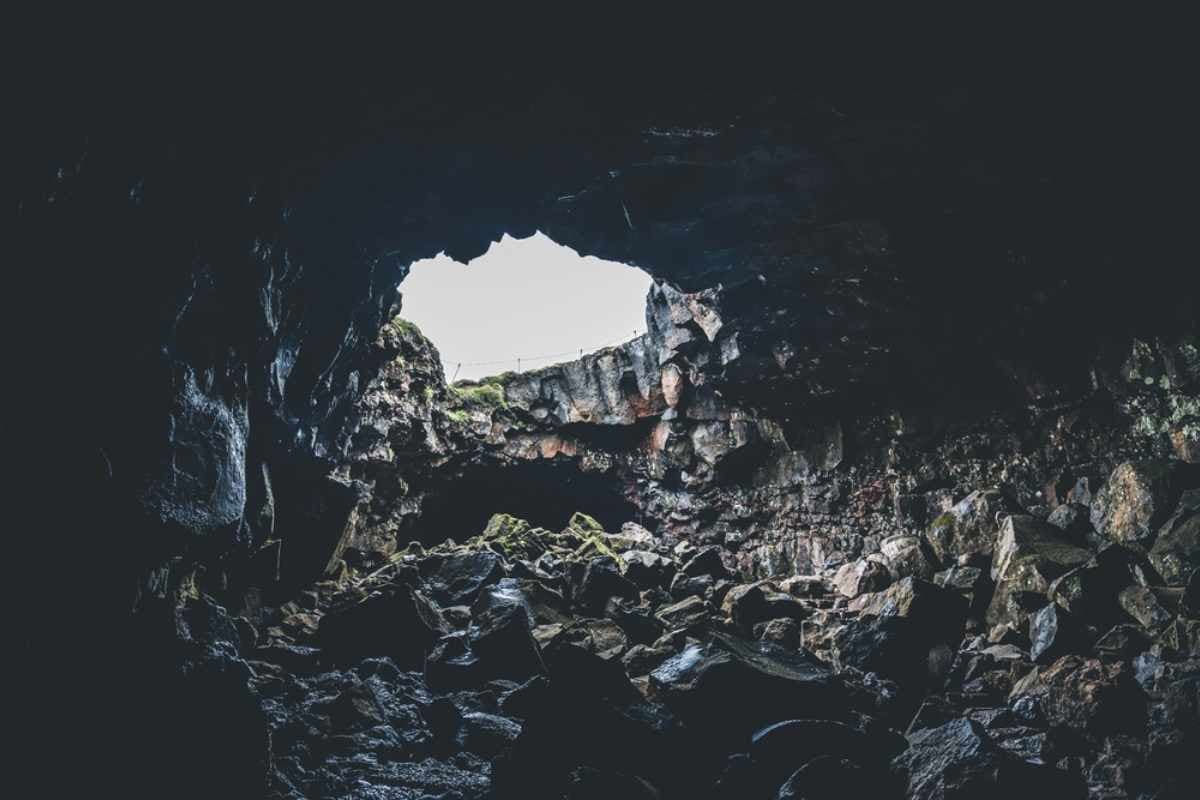
Expect a dark, close, uneven cave rather than a polished show tunnel. The appeal is texture: lava walls, broken floor, mineral stains, ice, and the quiet concentration of moving carefully.
Specialist and operator descriptions place the cave at roughly 360 meters long, with openings at both ends and a route that can involve walking, stooping, crawling, and climbing. Use that as a planning scale, not as a promise that every visitor should try the same route or continue through every section.
The strongest moments are small: a headlamp catching wet black lava, pale ice hanging from the ceiling, red-brown rock textures, and the sudden brightness of an entrance after minutes in the dark. The same details can feel stressful if you dislike enclosed spaces or awkward footing.
The cave is more about lava texture and close detail than broad scenery.Seasonal ice can make the cave more striking, but it also raises the need for caution.
Most travelers should treat Gjábakkahellir as a 45-90 minute cave stop near the route
Most travelers should treat Gjábakkahellir as a 45-90 minute cave stop near the route, with extra margin for finding the right access point, changing plans, and moving slowly inside.
The approach can sound short, but the useful visit is not just parking and stepping inside. You need time to assess the entrance, layer up, sort lighting, move carefully over loose rock, turn around early if the group is uncomfortable, and avoid letting the cave steal time from the main Golden Circle stops.
Quick version: look at the entrance, enter only the easy first section if conditions and group comfort are clearly good, then keep the Golden Circle moving.
Balanced version: make Gjábakkahellir the one extra Þingvellir-area stop and cut weaker small detours elsewhere.
Slow version: pair the cave with Þingvellir and one nearby geological stop, then leave Geysir and Gullfoss for a less compressed day.
Low passages and loose lava make group pace more important than map distance.
Pair Gjábakkahellir with nearby geology, not with every famous stop at once
Pair Gjábakkahellir with nearby geology, not with every famous stop at once. It works best when it adds contrast to Þingvellir rather than crowding the Golden Circle.
The cleanest version is Þingvellir plus Gjábakkahellir, with Almannagjá as the surface-rift comparison and Silfra as the clearer water-fissure comparison. If you still have time, add one easier scenic stop such as Kerið or Brúarfoss instead of forcing a long chain of extras.
For a first Golden Circle day, Geysir and Gullfoss usually deserve priority over a cave add-on. Gjábakkahellir is strongest for return visitors, geology-focused travelers, or groups who have already decided that a rough cave is more valuable than another viewpoint.
Gjábakkahellir: use official visitor, road, weather, safety, operator, and on-site information before entering
Use official visitor, road, weather, safety, operator, and on-site information before entering. Use this guide for planning, not live access or cave-safety confirmation.
The practical checks are simple: whether the approach and road conditions fit your vehicle, whether the weather makes the drive or entrance area unwise, whether everyone has proper light and footwear, and whether any local signs or operator advice changes the plan. Turn around early if the cave feels wrong for the group.
Do not rely on phone reception, casual map pins, or old trip reports once you are near the cave. If a facility, meeting point, guided option, or access detail matters to your day, verify visitor details with the relevant official or operator source before building the stop into a tight schedule.
Use weather and warning information before committing to cave access or a long driving day.
Gjábakkahellir FAQ
These are the questions that usually decide whether the cave belongs in a real trip plan.
Is Gjábakkahellir worth visiting?
Yes, if you specifically want a rough lava-tube experience near Þingvellir. Skip it if your Golden Circle day is already tight or your group wants easy surface sightseeing.
Do you need a guide for Gjábakkahellir?
A guide is the safer choice for many travelers because the cave is dark, rocky, and uneven. If you consider entering without one, use official safety guidance, proper equipment, and conservative judgment.
How hard is the cave?
It is not a polished show cave. Expect loose rock, darkness, low sections, possible crawling or stooping, cold surfaces, and seasonal ice.
Can Gjábakkahellir fit with Þingvellir, Geysir, and Gullfoss?
It can fit only when the day has spare time and the cave is a deliberate extra. For most first-time Golden Circle plans, protect Þingvellir, Geysir, and Gullfoss before adding the cave.