Kerið is a volcanic crater lake on the Golden Circle, useful as a short color-and-geology stop when your route has space beyond Gullfoss, Geysir, and Þingvellir, with enough flexibility for conditions and nearby route choices.
Geology snapshot
Type
Volcanic crater lake, viewpoint, and short walking stop
Region
South Iceland, on the Golden Circle near Route 35
Time to allow
About 20-30 minutes for a quick rim view, or 45-60 minutes if you walk the rim and go down to the lake
Best experience
Walk part or all of the rim first, then use the lake stairs if conditions and time allow
Access reality
Parking is close to the crater, but current admission/service details should be checked with the official site
In this guide
Is Kerið Crater worth adding to the Golden Circle?
Yes, Kerið Crater is worth adding when you want a compact, colorful stop that does not require a long hike. It is less essential if your Golden Circle day is already full with Þingvellir, Geysir, Gullfoss, food stops, and winter daylight limits.
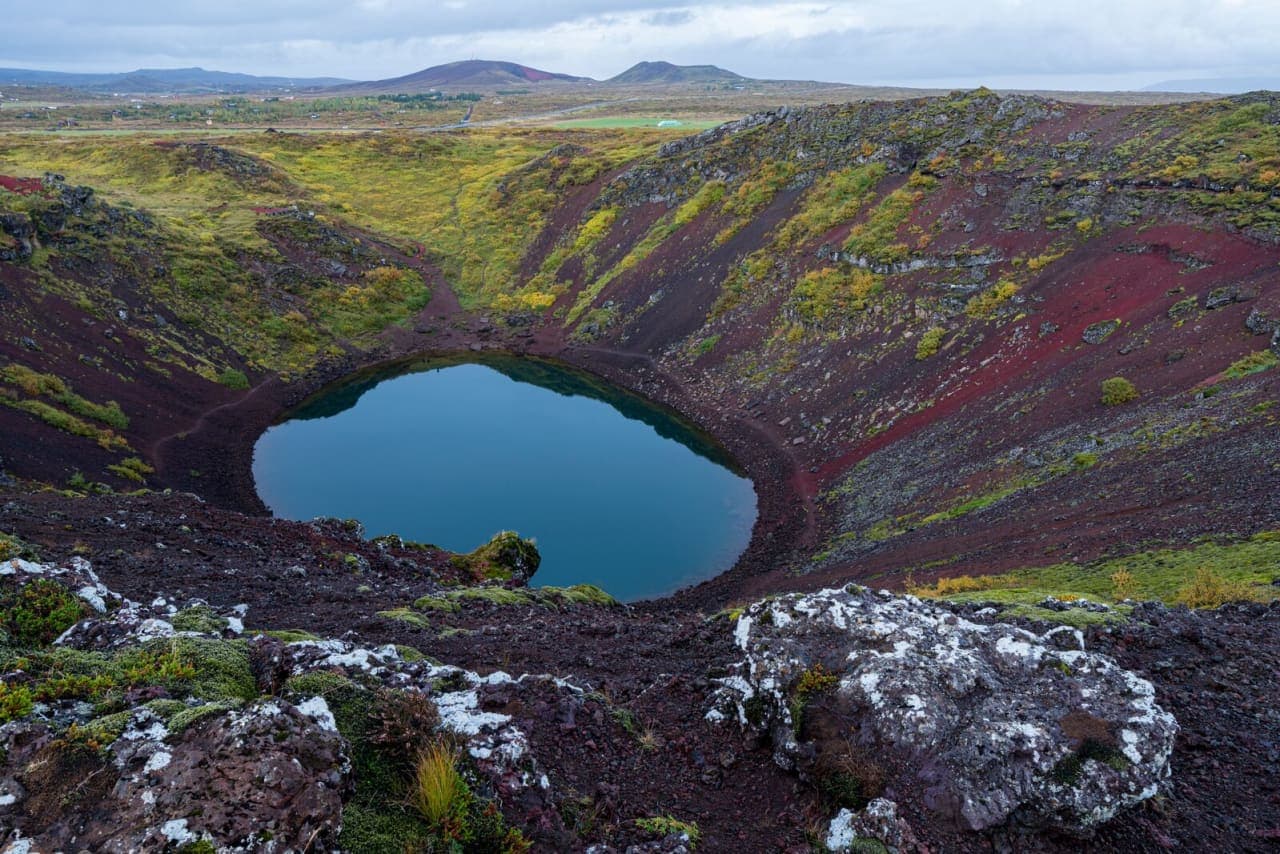
Kerið is easy to understand as soon as you arrive: a red volcanic bowl, a blue-green lake, a rim path, and stairs that lead toward the water. The appeal is not scale. It is the clean shape of the crater and how quickly it gives you a different landscape from the larger Golden Circle landmarks.
For most self-drive travelers, Kerið works best as a 30-60 minute stop near the beginning or end of the day. Add it when you have time to slow down; skip it when you are already rushing between the major stops.
Photo guide
Kerið Crater in photos
1 / 3
The parking area sits close to Kerið, which is why the stop can stay short when the day is tight.
What does Kerið feel like once you leave the car park?
The stop feels immediate. You are close to the crater almost as soon as you leave the parking area, so the first decision is whether to stay on the rim, walk the full edge, or go down toward the lake.
Kerið has a clear visual identity: dark red and brown volcanic slopes, patches of moss and grass, and a lake that can shift between blue, green, and darker tones depending on light. The rim is the best place to read the whole shape of the crater, while the lake-level path makes the walls feel taller and rougher.
The lake-level stairs show why Kerið can be more than a quick rim photo when paths are in good condition.
The visit is strongest when you give it enough time to see both angles. A fast rim photo is useful, but the lake descent adds texture: wooden steps, close-up volcanic rock, and the sense of standing inside the crater instead of only looking into it.
How much time do the rim path and lake stairs need?
Plan about 20-30 minutes for the simplest version and closer to 45-60 minutes if you want both the rim and lake-level path. The stop is easy by Iceland standards, but it is not completely flat.
Quick stop: park, walk to the rim, take in the crater view, and continue driving.
Better stop: walk part of the rim, compare a few viewpoints, and go down the stairs if conditions are good.
Fuller stop: circle the rim at an unhurried pace, descend to the lake, and leave time for wind, photos, and other visitors.
The rim path is the main payoff for most travelers because it shows the full crater shape. The lake stairs are worthwhile when you have stable footing and enough time, but they are the first part to cut if the weather is poor, the surface is icy, or someone in your group dislikes uneven steps.
Where Kerið works best in a Golden Circle day
Kerið works best as a flexible Golden Circle add-on, usually before or after the bigger stops rather than in the most crowded middle of the day.
If you are driving from Reykjavík, many travelers see Þingvellir, Geysir, and Gullfoss as the core trio, then decide whether Kerið adds enough variety on the way around. It pairs especially well when you want one compact volcanic landscape after waterfalls, geysers, and national-park scenery.
Kerið also makes sense when the day includes nearby smaller stops such as Brúarfoss Waterfall, Skálholt, or Secret Lagoon. Keep the pairing simple: too many short stops can make the day feel busy even when each one looks easy on the map.
If the crater leaves you wanting a more geology-led detour, compare Kerið with Skjaldbreiður; if the day needs river scenery instead, Brúarhlöð Canyon is the more compact add-on.
What changes with weather, daylight, and winter paths?
Kerið is accessible in many seasons, but the quality of the stop changes quickly with wind, ice, low light, and wet paths.
The rim is exposed, so wind can make a short stop feel colder and less comfortable than the parking distance suggests. In winter, darker light can make the crater moodier, but icy surfaces can also make the lake stairs and rim path less appealing.
Winter can make Kerið striking, but it also raises the value of checking wind, ice, daylight, and road conditions.
Before a winter or bad-weather drive, check the Icelandic road and weather services. Kerið is close to the road, but that does not remove the need to make a sensible call about footing, visibility, and whether the stop is worth keeping that day.
Kerið Crater: the best pairings depend on whether you want to stay with the classic Golden Circle or add a quieter nearby stop
The best pairings depend on whether you want to stay with the classic Golden Circle or add a quieter nearby stop.
Þingvellir is the strongest landscape-and-history anchor before Kerið if you are starting from Reykjavík.
Geysir and Gullfoss keep the day on the classic Golden Circle spine and make Kerið feel like a short volcanic contrast.
Brúarfoss Waterfall adds a smaller waterfall stop if you have already allowed enough time for the main trio.
Skálholt gives the day a cultural stop that is calmer than the major scenic landmarks.
Secret Lagoon works as a nearby geothermal soak when you want the day to end more slowly.
For a first Iceland trip, Kerið usually belongs in the same planning family as a 5-Day Iceland Itinerary or a South Iceland route decision. Keep it with the southwest portion of the trip so it does not compete with South Coast waterfall or glacier time.
Kerið is useful, but it is not compulsory
Kerið is useful, but it is not compulsory. It is easiest to skip when the day is already crowded or the conditions remove the main visual payoff.
Skip it if poor weather means you would only rush to the rim and leave.
Skip the lake stairs if paths are icy, muddy, or uncomfortable for your group.
Skip Kerið if you need more time at Þingvellir, Geysir, or Gullfoss and do not want a packed day.
Skip it if you are looking for a long hike, remote silence, or a free wilderness stop.
The right compromise is often a short rim visit. That gives you Kerið's color and crater shape without letting one extra stop crowd the rest of the Golden Circle.
Kerið Crater FAQ
These are the practical questions that most often change how much time Kerið deserves.
How long do you need at Kerið Crater?
Most travelers need 20-30 minutes for a quick rim stop, or 45-60 minutes for the rim and lake stairs. Allow more time if paths are icy, the stop is busy, or you want unhurried photos.
Is Kerið easy to visit on a Golden Circle drive?
Kerið is easy to visit by self-drive because the parking area is close to the crater. The walking surface still matters, especially on the stairs and exposed rim.
Do you need to check current admission before visiting Kerið?
Yes, you should check the official Kerið site for current admission, facilities, and visitor details. Avoid relying on old prices or opening claims from third-party pages.
Can you swim in Kerið Crater lake?
No, you should not plan to swim in Kerið Crater lake. Visit for the viewpoint, rim path, lake-level stairs, and crater scenery instead.
Is Kerið good in winter?
Kerið can be good in winter when roads and paths are manageable, but wind, ice, and daylight affect the visit. Check weather and road conditions before keeping it in a tight winter day.