Strýtur is a protected underwater geothermal chimney field in Eyjafjörður, North Iceland, worth planning only for qualified divers or geology-focused travelers who can build the visit around operator, weather, road, and sea-condition checks.
Coast snapshot
Type
Protected submarine geothermal chimney field and specialist dive attraction
Region
Eyjafjörður in North Iceland, near the Akureyri and Hjalteyri side of the fjord
Route context
Best treated as a North Iceland base objective, not a quick Ring Road photo stop
Time to allow
Plan it as a half-day or larger commitment once operator timing, weather, and sea conditions are confirmed
Best experience
Seeing active mineral chimneys underwater with a qualified local operator and enough route flexibility
In this guide
Strýtur is worth planning around if you are a qualified diver who wants one of Iceland’s most unusual geothermal sites
Strýtur is worth planning around if you are a qualified diver who wants one of Iceland’s most unusual geothermal sites. For most non-divers, it is better understood as a protected underwater landmark than as a practical attraction stop.
The direct answer is narrow: go if the dive is the point of the day, skip it if you need a visible roadside view. Strýtur sits underwater in Eyjafjörður, so the value comes from specialist access to the chimneys, not from a lookout, path, or casual detour.
Add Strýtur for an experienced diver already basing a slower North Iceland stay around Akureyri, Hjalteyri, or Eyjafjörður. Skip it for a first trip that is mainly about easy scenic stops such as Goðafoss, Lake Mývatn, and Dettifoss.
Photo guide
Strýtur in photos
Wildlife images broaden the page beyond chimney texture while staying exact to the dive-site context.
What makes the Strýtur chimneys unusual?
Strýtur is a shallow-water hydrothermal chimney system where geothermal fluids and seawater have built pale mineral towers on the seafloor. That combination makes it different from Iceland’s land-based geothermal areas.
Official protected-area information describes Hverastrýtur in Eyjafjörður as an underwater natural-interest area protected for its rare geothermal formations, fragile chimneys, and biological value. Scientific papers also describe active alkaline hydrothermal fluids and mineral precipitation around the field.
The protected site is about fragile mineral growth underwater, not surface scenery.
That is the main reason Strýtur earns an attraction page even though it is inaccessible to casual sightseeing. It helps explain the geothermal character of North Iceland in a way that is quite different from the steaming fields and volcanic landscapes travelers meet around Mývatn.
Who should plan a Strýtur dive, and who should skip it?
Plan Strýtur only if you can make the access checks part of the trip. The site is underwater, cold, protected, and operator-dependent, so suitability matters more than curiosity.
Strýtur planning decision
Choice
Use it when
Plan around
Go
You are a qualified diver and Strýtur is a main reason to be in North Iceland.
Operator guidance, sea conditions, weather, and enough time near Eyjafjörður.
Skip
You want an easy family stop, viewpoint, short walk, or flexible Ring Road pause.
You are interested but your route is tight or conditions look uncertain.
Official protected-area information, road conditions, weather, and travel-safety advice.
This is also where planning discipline matters. Do not let the rarity of the place override the day’s practical shape. If your North Iceland plan is already crowded, the better choice may be to keep Strýtur as a future dive objective and use the Diamond Circle Road Trip for a more visible landscape day.
How much time and route space should you allow?
Do not budget Strýtur like a short attraction stop. Once transport, briefing, conditions, gear, and route margin are included, it belongs in a half-day or slower North Iceland plan.
The exact commitment depends on the operator and conditions, so the durable planning rule is simple: leave enough space that the dive does not sit between two hard-driving obligations. If you are staying near Akureyri or Hjalteyri, that can work. If you are trying to cross a long part of Route 1 the same day, it is usually too much friction.
Quick curiosity: read about the protected site, then choose visible nearby stops.
Balanced dive plan: base in North Iceland and keep the rest of the day light.
Slow specialist plan: give weather, sea conditions, and operator advice room to shape the day.
In winter or rough weather, use winter driving guidance and official road/weather sources before treating any Akureyri-area plan as settled.
What does the underwater visit feel like?
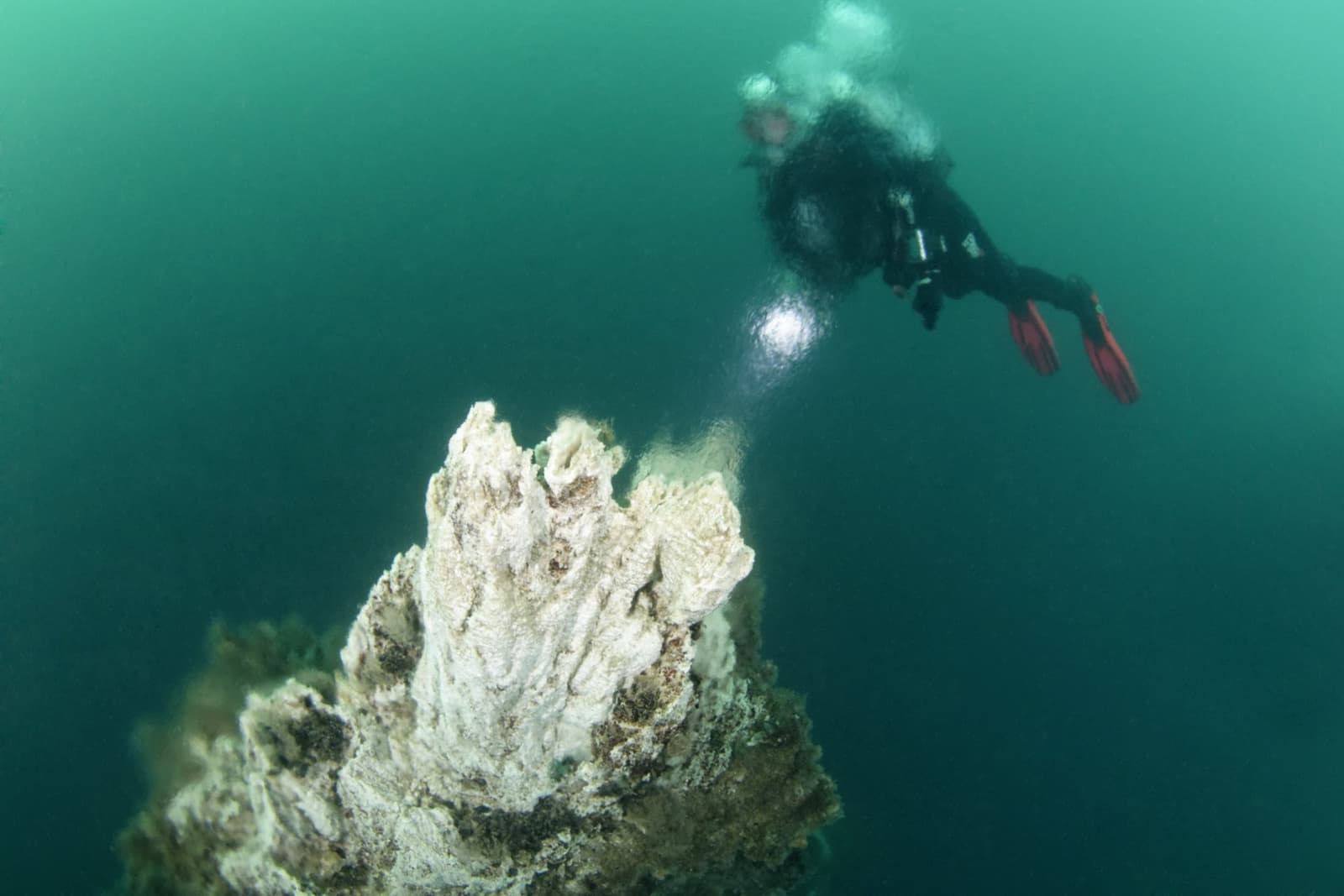
The visual experience is more intimate than grand: pale chimney walls, green northern water, bubbles, marine life, and the sense of hovering beside a geothermal structure that is still part of a living seafloor system.
The photographs tell the right story. Strýtur is not about a sweeping surface panorama. It is about scale, texture, and proximity: a diver beside mineral towers, details of pale deposits, and cold-water wildlife around the structures.
A diver in the frame shows why Strýtur is a scale-and-access decision, not a normal viewpoint.The strongest visual detail is close to the chimney surface, where mineral texture and scale meet.
That makes Strýtur especially rewarding for travelers who care about geology, unusual marine environments, and specialist diving. It is weaker for travelers who want a simple scenic payoff after parking the car.
Where does Strýtur fit with Goðafoss, Mývatn, and Dettifoss?
Strýtur fits best as an Akureyri- or Eyjafjörður-based side objective, while Goðafoss, Mývatn, and Dettifoss are easier visible anchors for most North Iceland routes.
If your trip already includes a North Iceland base, Strýtur can sit beside a slower fjord day. If your trip is a classic sightseeing loop, Goðafoss is the easier waterfall pause, Lake Mývatn gives broader geothermal and lava-field context, and Dettifoss adds canyon scale without specialist dive logistics.
Marine life is part of the appeal, but it also reinforces why the site should be approached carefully.
Use the North Iceland region guide to decide whether your trip has enough time in the north before adding a specialist plan. Use the Diamond Circle Road Trip if you need a more straightforward route built around visible landscapes and stronger first-trip stops.
Strýtur: let official and operator sources decide the final details
Let official and operator sources decide the final details. Strýtur is exactly the kind of place where durable planning advice is useful, but live conditions should control the actual decision.
Check protected-area guidance, operator visitor details, weather, road conditions, and general travel-safety advice before relying on the stop. If any of those checks are uncomfortable, choose a visible North Iceland alternative and keep Strýtur for a better-matched trip.
General travel-safety checks before committing to weather-sensitive plans.
Strýtur FAQ
These are the questions that matter before you decide whether Strýtur belongs in your route.
Can non-divers visit Strýtur?
Non-divers should not plan Strýtur as a normal attraction stop. The site is underwater, so most travelers will get more practical value from learning what it is and then choosing visible North Iceland stops nearby.
Is Strýtur a good first-trip Iceland stop?
Usually no. It is a specialist objective for qualified divers, while first-trip routes usually benefit more from visible places such as Goðafoss, Mývatn, or Dettifoss.
Should I book around Strýtur before planning the rest of North Iceland?
Only if the dive is a main purpose of your trip. Otherwise, build your North Iceland route first, then see whether operator guidance and conditions make Strýtur realistic.
What changes a Strýtur plan the most?
Weather, sea conditions, diver readiness, operator guidance, road conditions, and daylight can all change whether the plan is sensible. Check official and operator sources before relying on it.