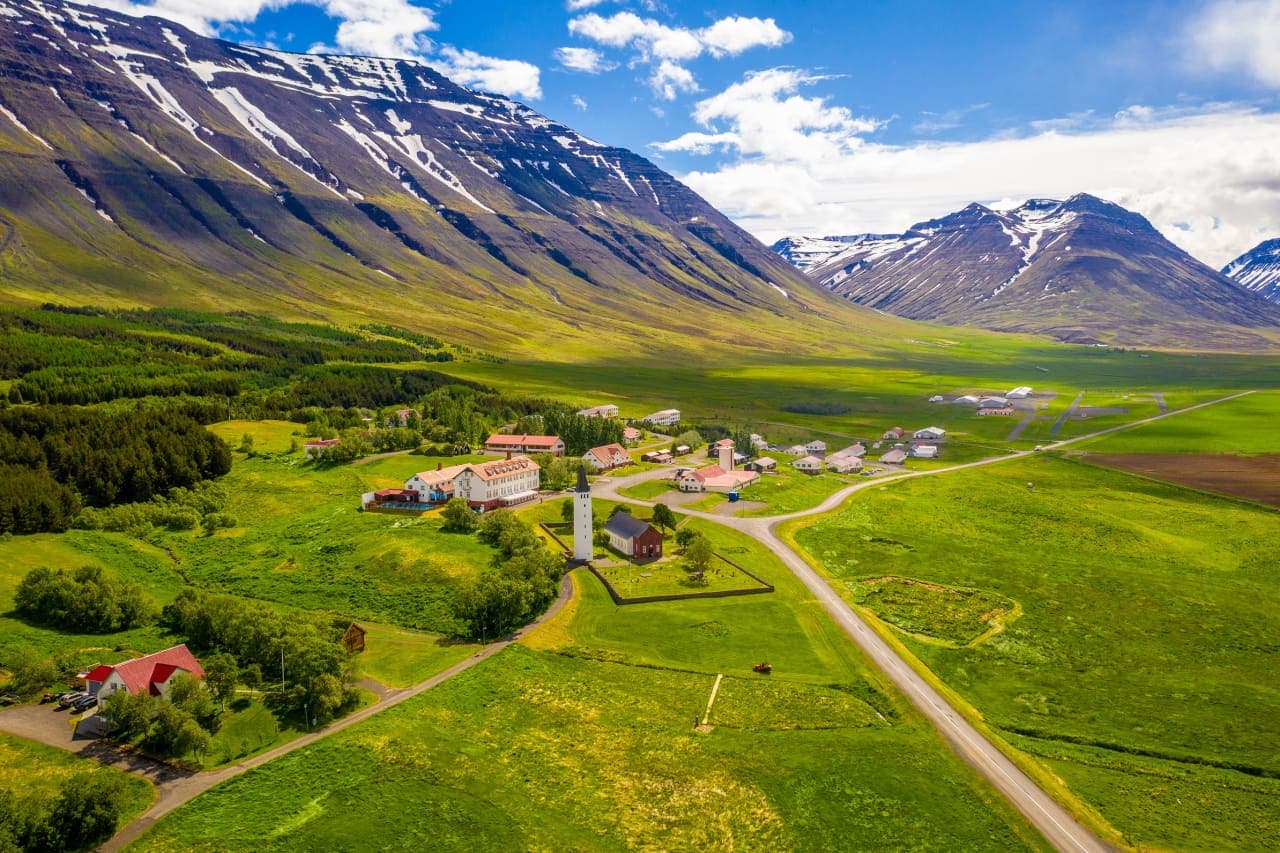
Hólar is a small university village and one of Iceland's most important church and learning sites. Its 1763 cathedral, Nýibær turf farm, horse-history exhibition and marked paths make a compact cultural stop in Hjaltadalur.
Historic site snapshot
Historic role
Northern episcopal see from 1106 and a long-running place of learning
Cathedral
Iceland's oldest stone church, completed in 1763
Nýibær
Northern-style turf farm built in 1860
Setting
Small university village in Hjaltadalur, Skagafjörður
Time to allow
About 1-2 hours for the historic core and a short walk
In this guide
Hóladómkirkja anchors a place of church and learning
Hólar is a living university village built around one of Iceland's most important religious and educational sites.
The northern episcopal see was established here in 1106, and teaching has remained part of Hólar's identity through changing institutions and centuries. The present settlement is small, but the cathedral, university buildings, churchyard and wooded slopes make its history visible in one compact part of North Iceland.
Hóladómkirkja gives the site its clearest landmark. Completed in 1763, it is Iceland's oldest stone church. Red sandstone from nearby Hólabyrða gives the building its warm color, while the separate tower rises above the churchyard. The Church of Iceland records Laurids de Thurah as the designer and protects the church for both its architecture and historic interior.
University of Iceland at Hólar keeps the village connected to its long educational role. Homes, teaching buildings and working grounds sit beside the historic monuments, so the central area feels like a small settlement with an unusually deep past rather than an isolated monument.
Church history, 1763 construction, designer, protected status and interior details.
Photo guide
Hólar in Hjaltadalur in photos
1 / 2
Nýibær gives Hólar a turf-house layer beyond the cathedral and university setting.
Nýibær and the horse centre widen the Hólar story
The cathedral is the anchor, while Nýibær and the horse-history exhibition show how people lived and worked around Hólar.
Hóladómkirkja holds the church history, architecture and many of the site's most important objects.
Nýibær is an 1860 turf farm with timber gables facing the yard, a clear example of the northern Icelandic farm type.
The Icelandic Horse History Centre occupies a 1931 stable and uses objects, film and staged displays to trace the horse's role in Icelandic life.
Nýibær has been under National Museum care since 1956, so its turf walls and rooms deserve the same care as any historic house. If turf architecture is your main interest, Glaumbær offers a more concentrated museum visit; Hólar earns its time from the combination of church, education, domestic history and the valley setting.
Access to the church, turf farm and exhibition can follow separate seasonal arrangements. Check the current listing for the specific interior you want to see, and treat the outdoor historic core as the part of the visit that always gives Hólar its shape.
The buildings stand close enough to explore on foot, but each rewards a different kind of attention: architecture and church objects at Hóladómkirkja, domestic construction at Nýibær, and material culture inside the horse centre. Choose two interiors when time is short instead of racing through all three.
The cathedral is the clearest visual anchor for Hólar's church history.
Current exhibition description, contact information and the history of the 1931 stable.
Hólaskógur paths continue the story outdoors
The marked History Trail is the easiest way to connect the churchyard, old settlement and wooded edge of Hólar.
A short circuit around the historic core suits most visits, and marked paths also continue into Hólaskógur. These walks add the valley and forest to the cultural story without turning Hólar into a hiking day. Pick up current route information locally before relying on a particular path.
Winter changes both the valley setting and the checks needed before the drive into Hjaltadalur.
One or two hours suits the Hólar historic core
About 1-2 hours is enough to see the cathedral area, walk between the main buildings and add either Nýibær or the horse exhibition when it is accessible.
Stay longer for a forest path, guided visit or a careful look inside several buildings. Hólar works well beside Sauðárkrókur or the coastal village of Hofsós, but its own historic layers deserve attention before the day moves on.
Individual opening times, exhibitions and services can change. Use the site operator for current visitor information and Umferðin for the Hjaltadalur approach in winter or unsettled conditions.