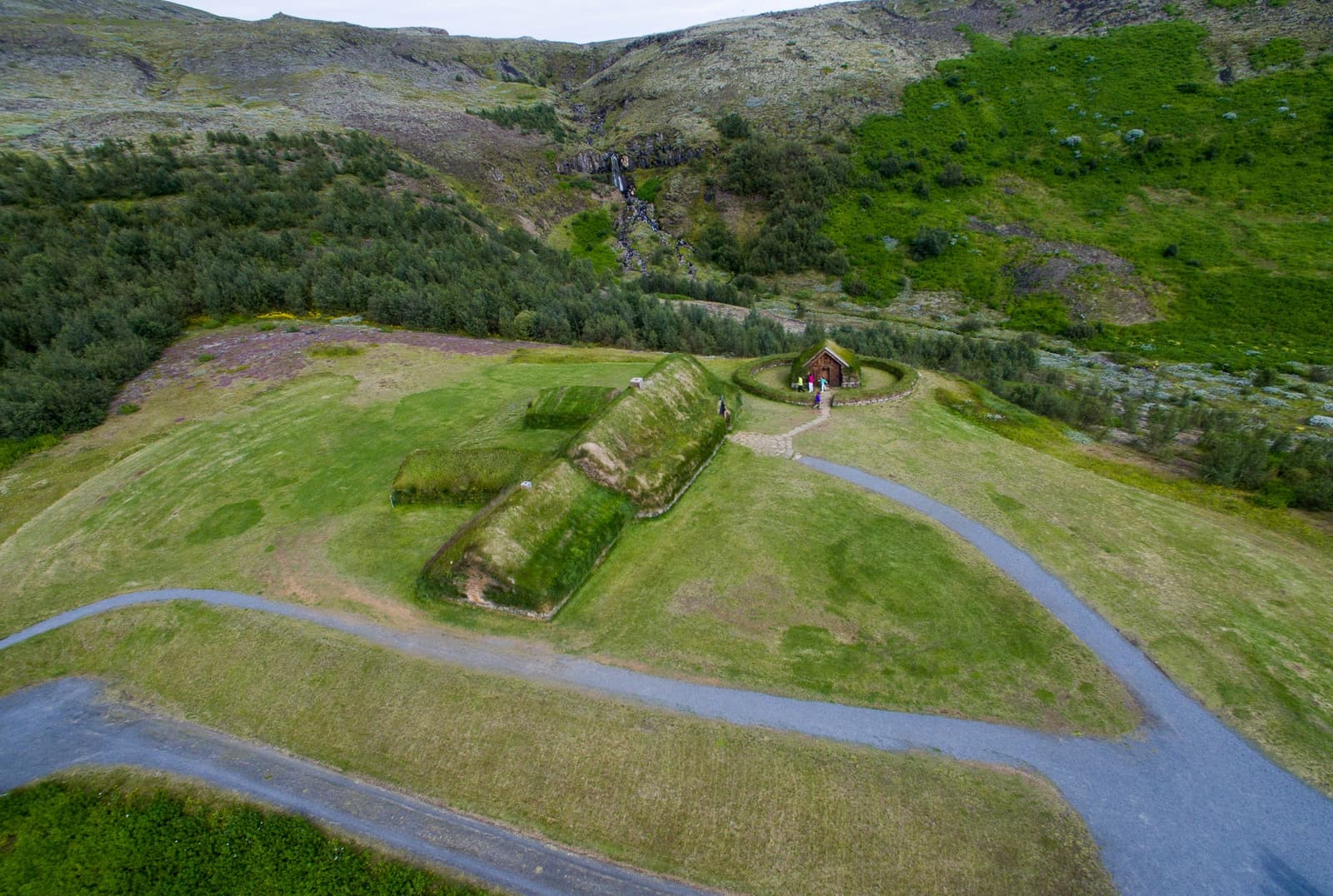
Þjóðveldisbærinn is a full-scale reconstruction of the medieval manor farm at Stöng, built to turn archaeological remains into a place visitors can enter and understand in Þjórsárdalur today.
Culture snapshot
What it is
Full-scale reconstruction of a manor farm from around 1100
Model
The excavated farmstead at Stöng in Þjórsárdalur
Built
Construction began in 1974; the farm opened in 1977
Time to allow
Roughly 45-90 minutes for the farm, church and interpretation
The farm gives the ruins at Stöng a human scale
Þjóðveldisbærinn is not the excavated farmstead itself. It is a full-scale reconstruction built nearby to show how a substantial Icelandic home may have looked around the year 1100.
Its model was Stöng, a manor farm in Þjórsárdalur buried by tephra from the Hekla eruption of 1104. The protected ruins preserve a plan, but the reconstruction turns that outline into connected rooms, walls, roofs and working spaces that visitors can enter.
The reconstructed farm works as a compact cultural stop inside a wider valley day.
The interior is the reason to stop
Platforms, benches, chambers, floor slabs, hearths, doors and storage vessels give the site more value than an exterior photograph alone.
The builders used the Stöng remains, written descriptions and evidence from other medieval dwellings to interpret missing details. The result is not presented as a perfectly preserved original. Its value is showing how construction, heat, work and social life fitted inside one large household.
The reconstructed interior turns an archaeological ground plan into rooms and working spaces.
A small church extends the story
The turf-roofed church beside the farm is a later reconstruction based on an 11th-century church ruin found at Stöng.
The farm reconstruction began in 1974 for the 1,100th anniversary of Iceland's settlement and opened in 1977. The church was built in 1999-2000, adding religious life to the household story rather than leaving the farm as an isolated domestic building.
The church helps present the reconstructed farm as a lived medieval site.
Plan a compact cultural visit
Allow roughly 45-90 minutes to explore the farm and church without rushing the interior interpretation.
There is only a short walk from the parking area, but access is seasonal. Check the operator's current visitor information before relying on entry. The farm fits naturally into a day already focused on Þjórsárdalur; Hjálparfoss or Gjáin adds nearby landscape for visitors who want another stop.