
Laufás preserves a prosperous Eyjafjörður vicarage

The old farm, church and furnished rooms make Laufás one of the clearest places to see how a substantial rural household once worked in North Iceland.

Laufás appears in records soon after Iceland's settlement and has had a church since the country's early Christian period. Priests are documented here from at least 1047, and the site developed into a wealthy vicarage with enough land and resources to support a much larger household than a small subsistence farm.

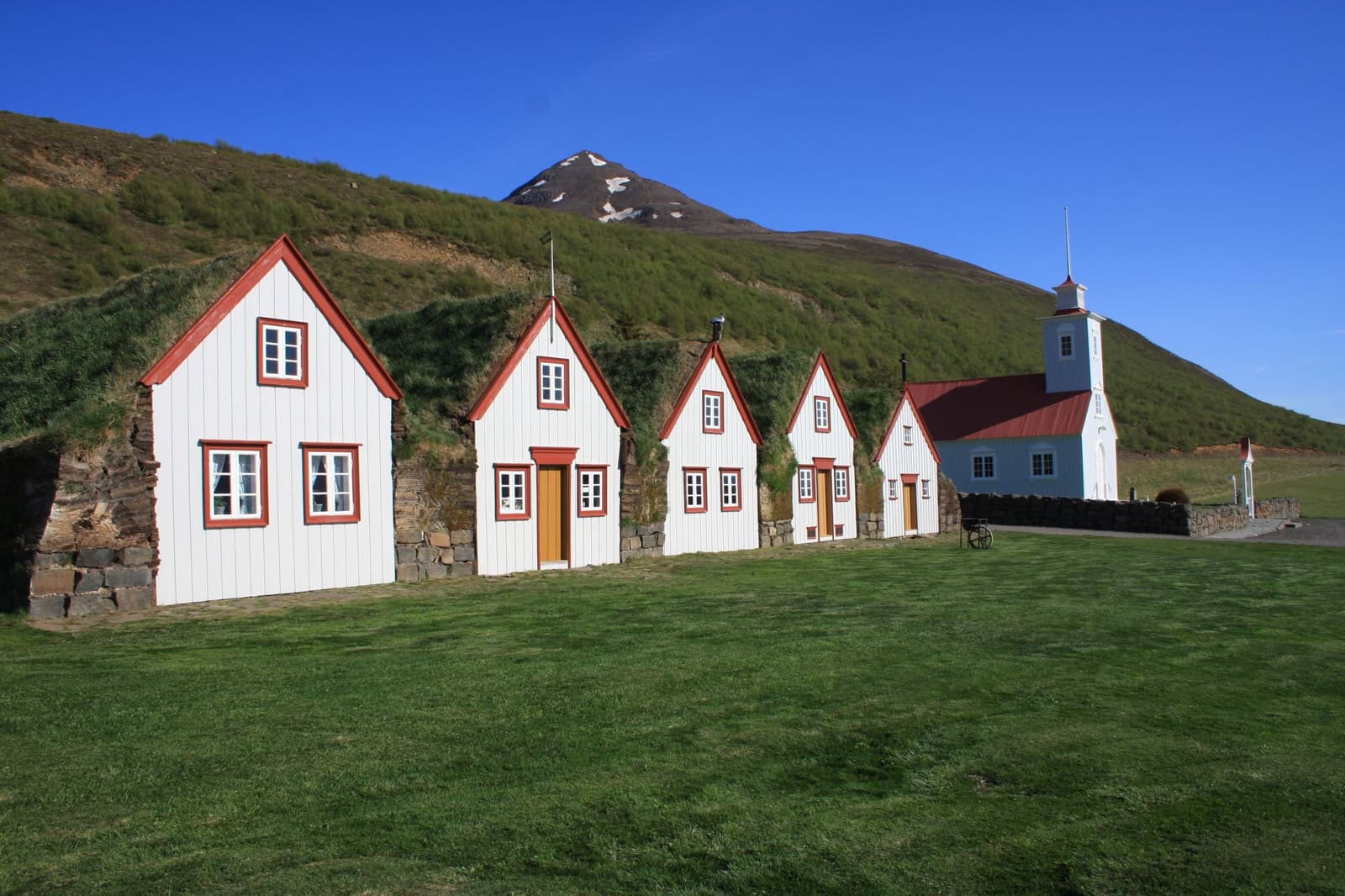
The old farm commonly housed 20-30 people. Most of the connected turf buildings seen today date from the mid-19th century, although older timbers survive within the complex. Their white gables face the yard while turf walls and roofs provide the insulation that shaped traditional Icelandic building.

History of Laufás

Connected rooms reveal work, status and daily life

The interior is a maze of passages and rooms rather than a single preserved cottage.

Household objects, clothing, storage spaces and work areas recreate the farm around 1900. Moving between them shows how domestic life, food storage and farm work shared one connected structure. A bridal room, where women prepared for weddings in the neighboring church, ties the house directly to the site's religious role.

Furnished rooms make the scale and organization of the old household easier to understand.
Wooden interior room at Laufás with turf walls, beams, shelves and household objects.

Furnished rooms make the scale and organization of the old household easier to understand.

The church built in 1865 completes the farmyard

The present church is younger than the religious history of the site but contains objects that reach further back.

Laufáskirkja was built in 1865 beside the turf farm. Its most notable object is a carved pulpit dated 1698. Seen together, the church, farmyard and repeated gables explain why Laufás is a complete historic place rather than a collection of detached exhibits.

The turf farm and church belong to one long-lived religious and agricultural site.
White timber gables and turf roofs at Laufás with the church and hillside behind.

The turf farm and church belong to one long-lived religious and agricultural site.

Allow time for both the farmyard and interiors

About 45-90 minutes suits most visits, depending on current interior access and how closely you explore the rooms.

Laufás is a compact cultural stop in North Iceland, roughly half an hour by road from Akureyri. The exterior still communicates the site's form, but the furnished rooms provide much of its depth, so check the museum's visitor information before relying on an indoor visit. Goðafoss provides a strong natural contrast when the day has room for both.

Current visitor information