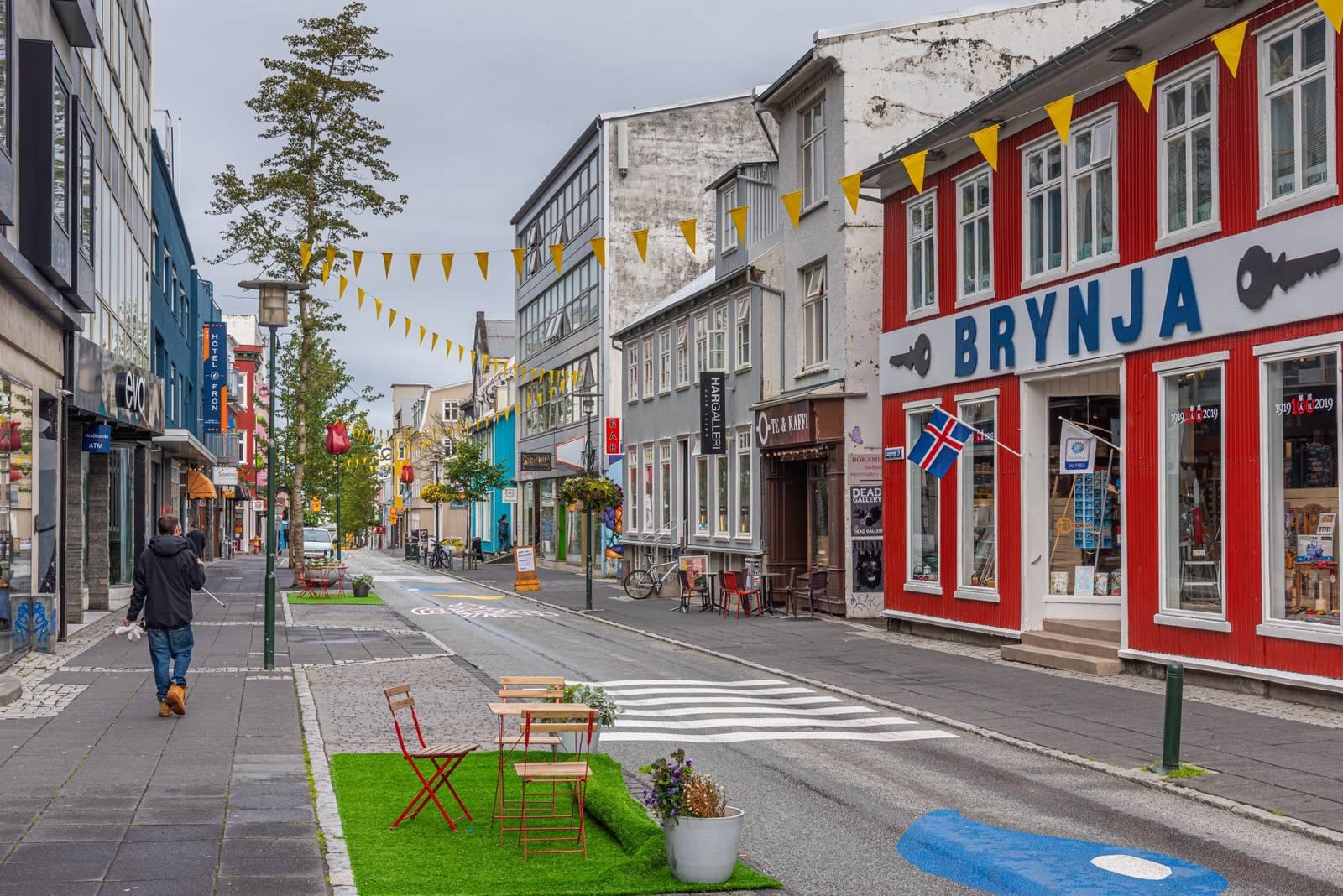
Laugavegur is Reykjavík's historic main street, evolving from the route to Laugardalur's washing pools into a lively corridor of shops, cafés, street art and nightlife in the city center today.
City stop snapshot
What it is
Historic main street and central shopping corridor
Name
Laugavegur means Wash Road
Origin
Route toward the washing pools in Laugardalur
Time to allow
About 30-60 minutes for a walk, longer with chosen stops
Do not confuse it with
The multi-day Laugavegur hiking trail in the Highlands
In this guide
Laugavegur is Reykjavík's main street, not a single sight
The street is valuable for its movement and variety: compact buildings, shops, cafés, murals, side streets and the changing rhythm of central Reykjavík.
Laugavegur runs through the heart of the city center and remains Reykjavík's best-known shopping street. During the day it carries shoppers, residents and visitors between small storefronts and adjoining streets. Later, restaurants, bars and music venues give parts of it a stronger evening character.
Its appeal is cumulative rather than monumental. One block may be busy and commercial, the next may reveal an older timber or corrugated building, and a side wall may hold a large mural. Visitors who want one famous object can find the street underwhelming; those who want to feel the center at walking speed usually understand it quickly.
Historic shopping-street and present-day city-life context.
Photo guide
Laugavegur in photos
1 / 2
Use specific shops and cafes as flexible stops, not as guaranteed itinerary anchors.
The Wash Road name comes from hard physical work
Laugavegur means Wash Road, a reference to the route women used when carrying Reykjavík's laundry to the geothermal washing pools in Laugardalur.
Before a proper road, the journey crossed rough and sometimes dangerous ground. Housewives and domestic workers carried not only heavy laundry but tubs, boards, soap, food and other equipment. Reykjavík City's historical account records that road construction began in 1885 to make the washing pools easier to reach.
Laundry was still taken to the pools until 1930. That history gives the modern street more depth than the usual description of it as a shopping area: its name preserves a route of labor that once extended well beyond today's central retail blocks.
The present pedestrian-scale street is far removed from the rough route used to reach Laugardalur's washing pools.
Municipal history of Laugavegur and the washing-pool route.
Look beyond the storefronts
Shopping is the most obvious activity, but older buildings, painted walls and nearby streets make the walk more interesting than a list of businesses.
The mix changes often, so a durable visit should not depend on one café, store or bar. Browse what is actually open, notice the building scale and take short detours when a mural or lane catches your eye. Skólavörðustígur branches uphill toward Hallgrímskirkja, while quieter Hverfisgata runs broadly parallel.
Murals and side-street details reward visitors who treat Laugavegur as a walk rather than a shopping checklist.
The street also changes by time of day. A calm morning walk, a busy afternoon and a late evening can feel like different places. Choose the atmosphere that suits the visit instead of assuming the street has one fixed experience.
A simple walk needs about 30-60 minutes
That is enough to understand the central stretch without shopping or stopping for a meal; allow longer only when specific places genuinely interest you.
Laugavegur connects easily with nearby landmarks but does not need a full route plan. Hallgrímskirkja sits uphill from the western shopping area, while Harpa and Sun Voyager draw the walk toward the waterfront. Pick one direction rather than turning every nearby pin into a requirement.
Parts of Laugavegur and adjoining streets operate as pedestrian areas. If arriving by car, check Reykjavík City's guidance instead of assuming through-driving or curbside parking. On foot, remember that this urban Laugavegur is unrelated to the multi-day Highlands hiking trail with the same name.