Reykjahlíð is the village that makes a Lake Mývatn trip easier, useful when you want a practical North Iceland base, a lava-edge church, and a few low-key village stops, but not when you need one dramatic standalone attraction.
Town snapshot
Type
Village base in a volcanic lake district
Region
North Iceland by the north shore of Lake Mývatn
Best use
Base yourself here for Mývatn's main sights
Time
30-90 minutes in town, longer if staying
Standout
Lava-edge church, bird museum, local services
In this guide
Is Reykjahlíð worth time beyond Lake Mývatn?
Usually yes, but only in a narrow way. Reykjahlíð is useful because it gives the Mývatn area a practical village center, not because it competes with the strongest volcanic sights nearby.
If your day already includes Lake Mývatn, Reykjahlíð can make the area feel easier to use. You get a real village, a recognizable church, official visitor information, and a handful of low-effort stops without pretending the village itself is the main spectacle.
The weaker version is treating Reykjahlíð like another standalone scenic detour. Travelers coming only for one dramatic viewpoint will usually get more from Dimmuborgir, Hverir Geothermal Area, Grjótagjá, or Krafla.
Photo guide
Reykjahlíð in photos
1 / 2
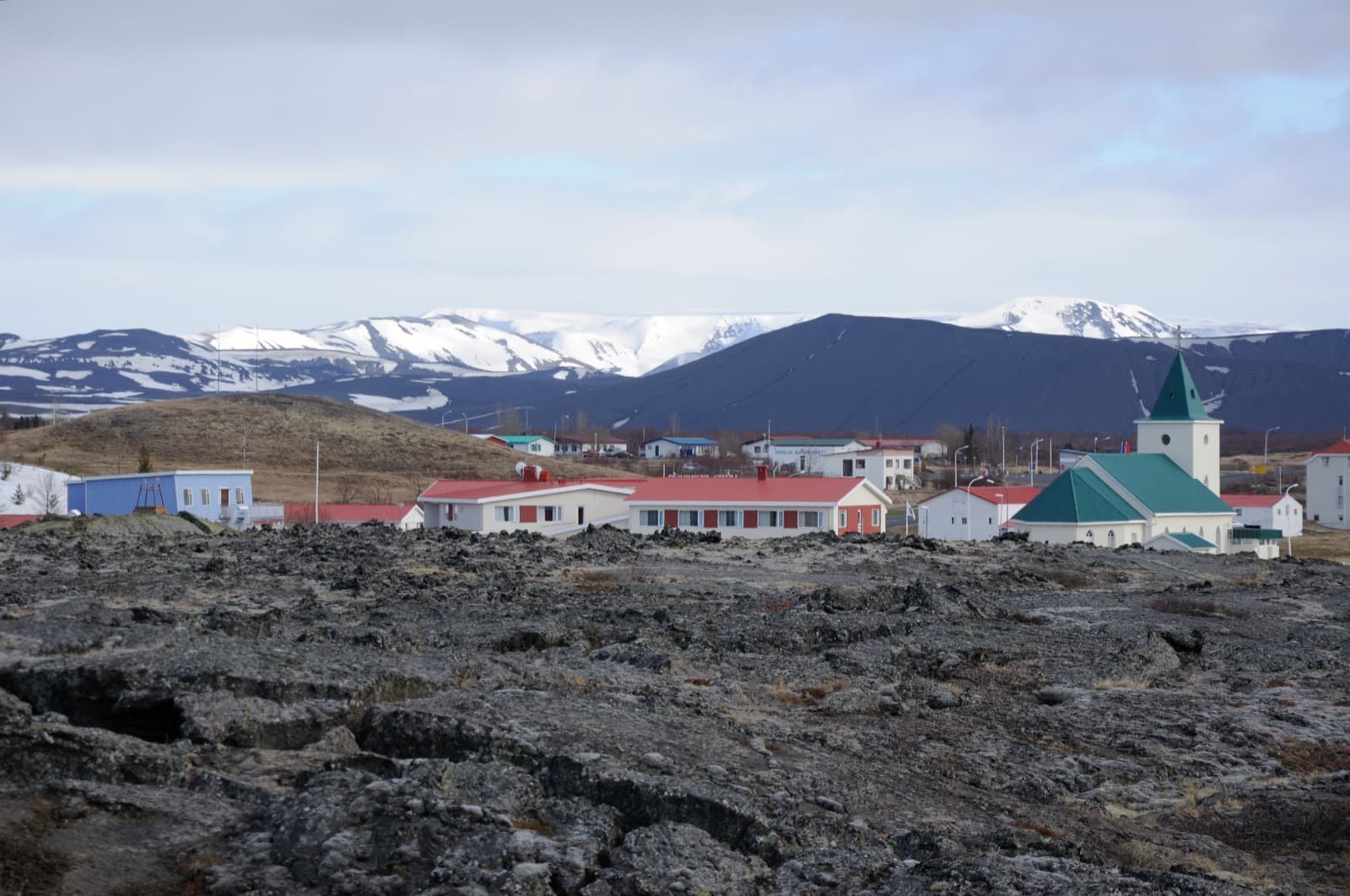
If you only stop once in the village itself, the church is the clearest place-led anchor.
Why does Reykjahlíð make the Mývatn area easier?
Because it gives the volcanic landscape a human center. Reykjahlíð is where the Mývatn district becomes easier to sequence, pause, and understand.
The village sits on the north side of the lake and works as the most practical place to pause between bigger nearby stops. That matters in a district where one short drive can take you from lake views to lava formations, geothermal ground, cave stops, and crater walks.
Reykjahlíð also adds a layer the larger attractions do not. Reykjahlíðarkirkja, rebuilt after the Krafla fires, gives the area a local survival story rather than another geology-only stop. If you want one more reason to pause, the village also carries a birding and visitor-information angle that fits travelers already curious about the ecology of Lake Mývatn.
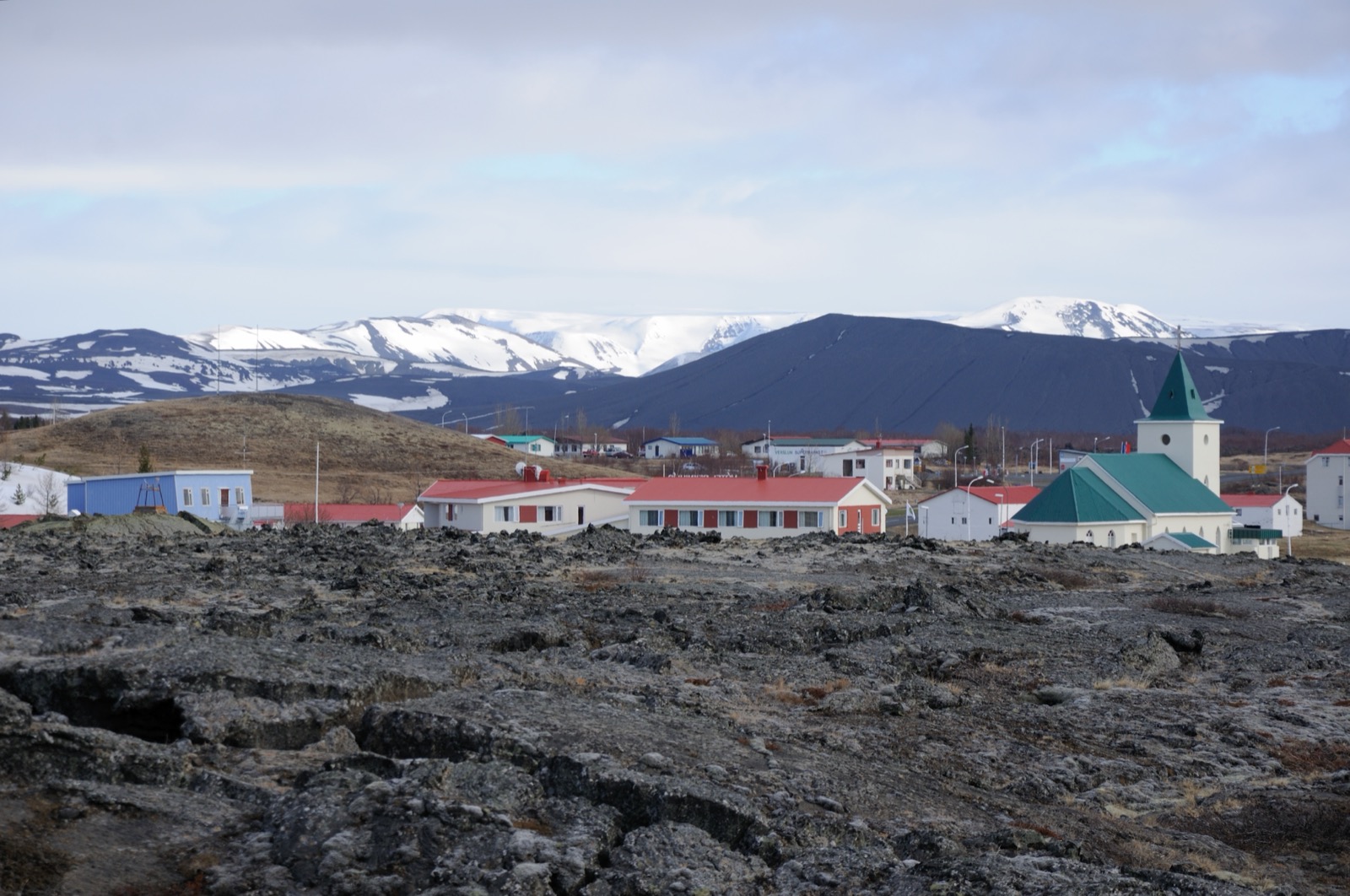
From above, Reykjahlíð reads as a small practical base inside a much larger volcanic landscape.The church-and-lava pairing is what gives Reykjahlíð a stronger local identity than a generic service stop.
What should you actually stop for in the village?
Keep expectations small and specific: church, local context, and a better grip on the wider district.
Walk to Reykjahlíðarkirkja if you want the village's clearest historic and visual anchor.
Use the official visitor-information point when nearby access, trails, or protected-area details matter.
Pause for the Bird Museum or other local stops only if you want a slower Mývatn day with an ecology angle.
Treat the village streets and lake-edge setting as a pause between bigger nearby sights, not as a long urban wander.
That mix is exactly why Reykjahlíð can be worthwhile. It is not busy enough to become a destination town, but it gives the Mývatn cluster a place where your day can feel less like a chain of pullouts.
The church is the village's clearest landmark, and it works because the lake and volcanic terrain still read around it.The church earns more than a roadside glance if you care about Reykjahlíð's local history rather than only nearby geology.
If your main interest is still volcanic texture, leave most of your time for Dimmuborgir, Grjótagjá, Hverir Geothermal Area, and Krafla. Reykjahlíð works best before, after, or between those stops.
How much time does Reykjahlíð need?
Think in versions rather than one fixed stop length.
Practical ways to use Reykjahlíð
Version
Best use
Time
Short village pause
Church, quick look around, and official visitor check before moving on
30 to 45 minutes
Low-key stop
Church plus one local museum, service stop, or slower village pause
45 to 90 minutes
Base, not a stop
Use Reykjahlíð to organize a full Mývatn area day or overnight
Several hours across the day
The village becomes more convincing the more selective you are. A short stop is enough if the goal is context and orientation. A longer version makes sense only when Reykjahlíð is helping you manage a broader Mývatn day rather than replacing it.
Reykjahlíð is easy to treat as a practical pause because the village is small enough to understand quickly from the road.The wider setting explains why Reykjahlíð is strongest as a practical base inside the volcanic district rather than a long standalone stop.
If you are already planning Mývatn Nature Baths or the hiking side of Krafla and Leirhnjúkur, staying or pausing in Reykjahlíð can simplify the day more than another extra detour.
What should you check before using Reykjahlíð as a base?
Check the living details around the village rather than assuming the whole district behaves like one fixed attraction.
The key checks are official road conditions, weather, protected-area guidance, and any visitor details tied to the church, museum, baths, or nearby geothermal and cave stops. Reykjahlíð itself is easy enough to understand; the wider Mývatn cluster is where conditions and access matter more.
That is why the village is most useful as a planning hinge. It lets you shorten or stretch the day after you confirm what is practical around the lake and volcanic sites.