
Church details
- Built
- Construction began in 1931; consecrated on October 14, 1934
- Architect
- Guðjón Samúelsson
- Building
- Reinforced concrete, with seating for about 160 people
- Interior
- Confirm with the parish before relying on entry
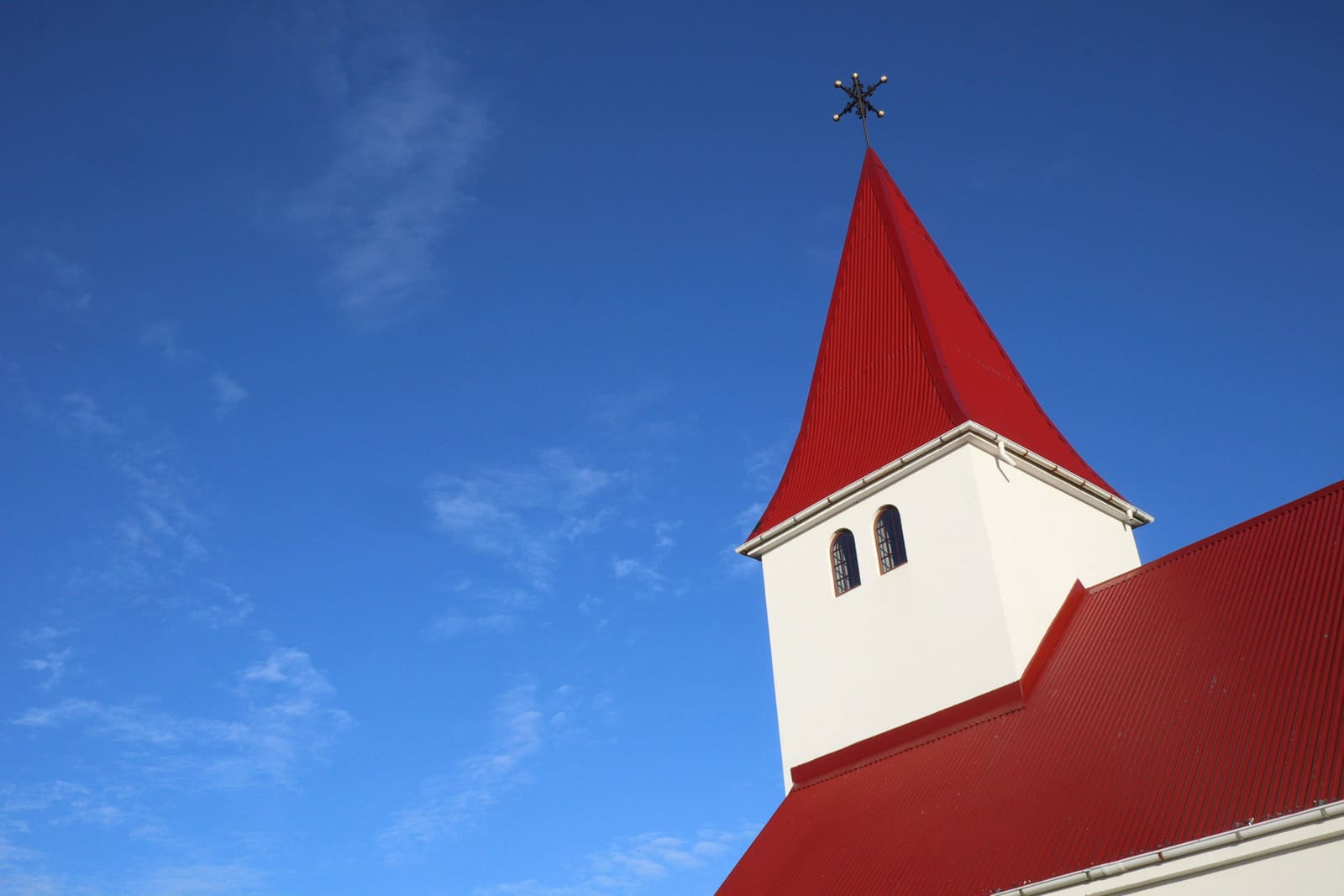
Víkurkirkja is Vík's white concrete church with a red roof, built between 1931 and 1934 on the hill above the village. It remains an active place of worship as well as one of the town's clearest landmarks.
Church details
Víkurkirkja is the red-roofed church that stands on the hill above Vík. Construction began in 1931, and the building was consecrated on October 14, 1934.
The Church of Iceland describes it as a reinforced-concrete church designed by State Architect Guðjón Samúelsson, with room for about 160 people. It is not simply a viewpoint or a photo prop: it serves the local parish and remains part of religious life in Mýrdalur.
Its position makes the building easy to recognize from much of the village. The white walls and steep red roof are simple, but the contrast with the dark slopes and changing coastal weather gives the church a strong presence.
Construction, consecration, architect, material, capacity, interior objects and parish contact details.
Local benefice and church-life context in Mýrdalur.
Photo guide
1 / 4
Snow reduces the landscape to the church's white walls, red roof and exposed hilltop position.
The church has a compact rectangular nave, a front tower and a steep red roof. Its restrained form is easier to appreciate up close than from the road below.
Inside, the official church record identifies stained-glass works by Hrafnhildur Ágústsdóttir and an altarpiece painted by Brynjólfur Þórðarson as a copy after Carl Bloch. It also records silver objects transferred from Höfðabrekkukirkja, an eleven-stop organ and two bells.
Those details matter because the exterior can otherwise make Víkurkirkja look like a decorative South Coast landmark. The building is modest in scale, but it carries the material history of older churches and the continuing life of the local congregation.
The exterior and church grounds are the dependable parts of a visit. The official church page provides parish contacts but does not promise routine sightseeing access to the interior.
Treat interior access as conditional rather than assumed. If seeing the stained glass, altarpiece or other objects matters to you, contact the parish or check its notices before going. Even when the door is closed, the architecture and village setting remain visible outside.
Remember that this is an active church. Stay quiet around services and ceremonies, avoid blocking entrances, and do not treat the grounds as a staged photo set when local worship is taking place.
From the hill, Víkurkirkja connects the village with the coast below: roofs spread toward the black sand, while steep green or snow-covered slopes rise behind the church.
This wider setting explains why the church has become such a familiar image of Vík í Mýrdal. The building provides a fixed point in a landscape shaped by low cloud, strong wind and fast-changing light.
The church view also places Víkurfjara and the offshore Reynisdrangar in context. Those are separate coastal places with their own conditions and safety considerations; Víkurkirkja is the cultural landmark above them, not a substitute for visiting the shore.
Regional context for Vík, its coastal setting and nearby visitor places.
By ThorPublished Updated