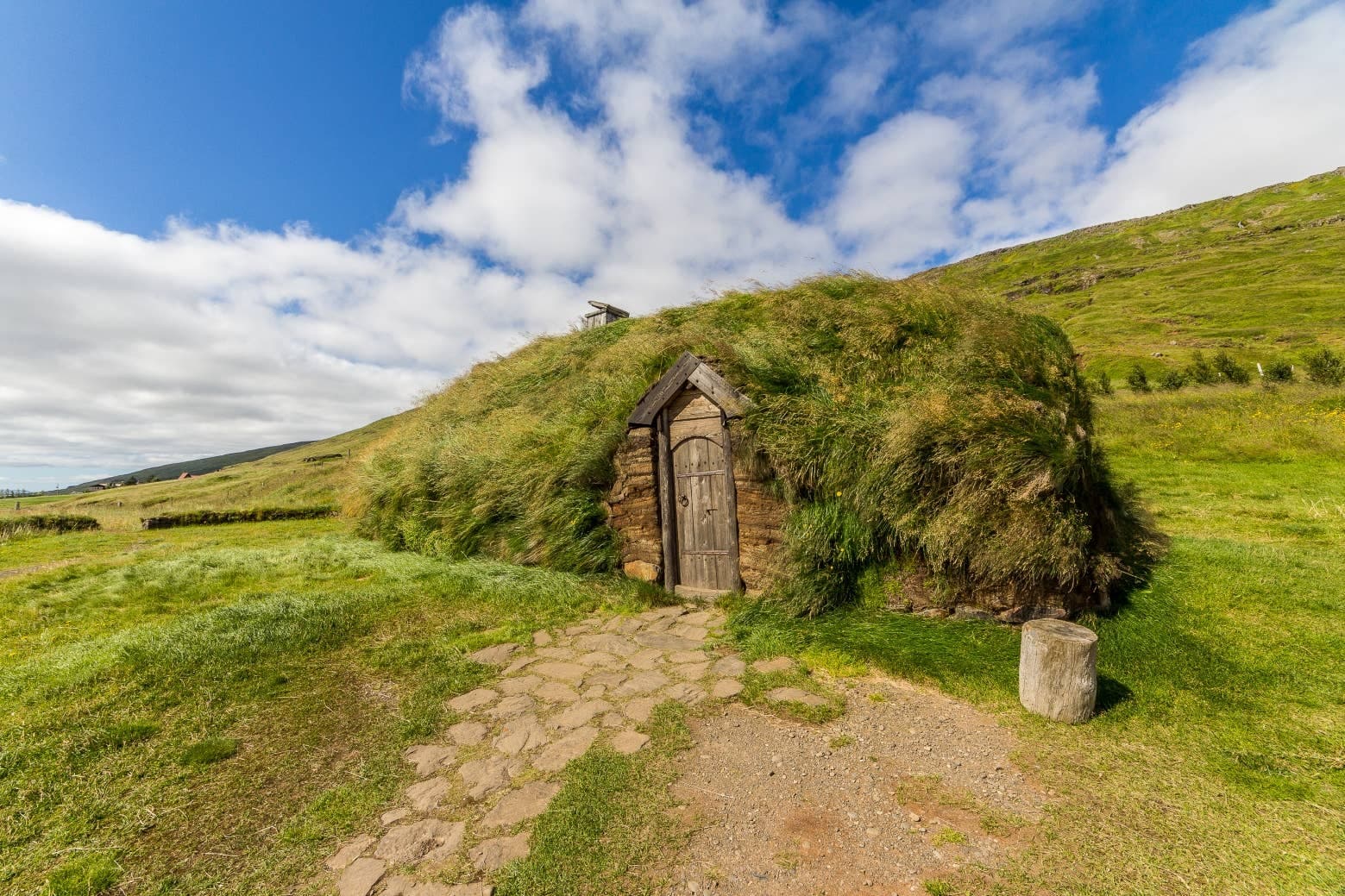
Eiríksstaðir brings one Viking-age farm into focus through a reconstructed turf longhouse, unscripted storytelling, and the foundation walls of the original farmstead associated with Eirík the Red and Leif Eiríksson.
Culture snapshot
What it is
Living-history longhouse and original farmstead remains
Reconstruction
Built in 1999 as an experimental-archaeology project
Location
Haukadalur in Dalir, near Búðardalur in West Iceland
Visitor format
English storytelling in the longhouse plus an outdoor ruins path
Eiríksstaðir is a farm story, not a generic Viking display
The museum stands at the farmstead that the Icelandic sagas associate with Eirík the Red and the childhood of his son Leif Eiríksson.
The surviving foundation walls give Eiríksstaðir its importance. They connect the Saga of Eirík the Red and the Saga of the Greenlanders to a specific valley in Dalir, where archaeology has also revealed how a tenth-century farm was arranged. The museum uses that evidence to interpret domestic life before the family's westward voyages became the better-known part of the story.
This makes Eiríksstaðir different from a collection of Viking objects behind glass. Its subject is one household: how people cooked, worked, slept, made clothing, and shared stories in a turf building. Leifsbúð in nearby Búðardalur continues the Leif Eiríksson and Vínland story, but Eiríksstaðir is the place where the farm setting itself matters.
The museum's account of the sagas, excavated farm, and evidence used for the replica.
Photo guide
Eiríksstaðir Living History Museum in photos
1 / 2
The turf-house entrance makes the reconstruction's low walls and grass roof clear.
Inside the reconstructed longhouse
The turf longhouse was built to scale in 1999 using experimental-archaeology methods, tools, and materials available in medieval Iceland.
Inside, guides in period clothing tell the story in English around the fire. The presentation is intentionally not a fixed scripted tour: visitors can join the ongoing storytelling, ask questions, handle reproductions, and learn about turf-house construction. The low, shared room is the main exhibit, because its proportions make everyday life easier to understand than a written timeline alone.
Archaeological remains at the farmstead connect the reconstructed house to the original site.
Outside, a tarmac path passes a statue of Leif Eiríksson and continues toward the archaeological area. A woodchip branch reaches the excavated longhouse and pithouse foundations; the operator identifies the continuing tarmac path as an alternative for visitors who have difficulty on woodchips. Remains from a separate experimental burning project also stand along the path, so the charred gables are modern research evidence, not the original Viking-age house.
Check the current season before driving to Eiríksstaðir
Eiríksstaðir is a seasonal, staffed museum, and its own visitor page should decide when you go.
Published opening periods can differ between listings, so use the museum's own information for dates, hours, tickets, and group arrangements rather than relying on an older travel guide. The site is in Haukadalur near Búðardalur, within the West Iceland region, and deserves time for the storytelling and ruins rather than only an exterior photograph. Guðrúnarlaug is a separate outdoor bathing stop elsewhere in Dalir, not an extension of the museum visit.