
City stop snapshot
- Artist
- Ólöf Nordal
- Commission
- HB Grandi commissioned the artwork in 2013
- Form
- An 8 m grass-covered mound with a spiral path and fish-drying shed
- Visit length
- About 20-30 minutes at the artwork
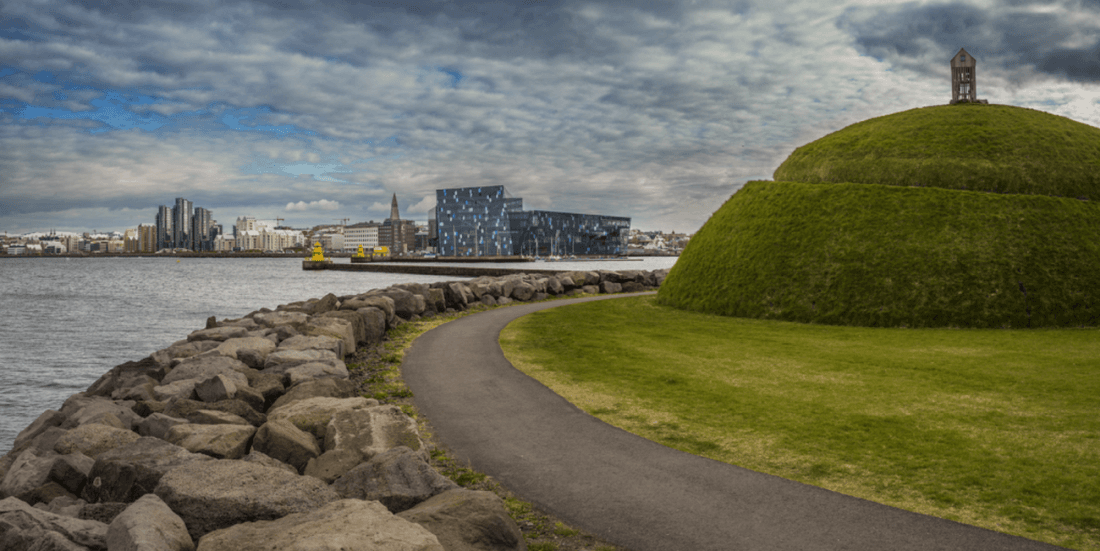
Þúfa is a grass-covered public artwork on Reykjavík's harbour edge. A spiral path climbs the man-made mound to a fish-drying shed and wide views across the water to the city and mountains.
City stop snapshot
Icelandic artist Ólöf Nordal designed Þúfa as a man-made mound where the city meets the working harbour.
The Icelandic word þúfa means a tussock or small hummock. Here that modest landform is enlarged into an eight-meter-high public artwork on reclaimed harbour land. A path coils around the grass-covered slope instead of climbing straight to the top.
A wooden fish-drying shed stands at the summit. It connects the quiet, almost rural-looking mound with Grandi's history as a fishing and fish-processing district. HB Grandi commissioned the work in 2013.
Artist, commission, dimensions, design and harbour setting.
The artist's project record and fish-drying shed.
Photo guide
Þúfa in summer light by Reykjavík harbour.
Walking the spiral path gradually raises the harbour, skyline and mountains into view.
The climb is short, and a focused visit usually takes about 20-30 minutes. At the top, the view reaches across the Old Harbour toward Harpa and central Reykjavík, with Mount Esja beyond the water in clear weather. The mound also reads differently from each side as you circle it.
Þúfa is more rewarding as a small work encountered slowly than as a checklist sight. Its scale, the smell and activity of the harbour, and the traditional shed matter as much as the panorama.
District identity and Þúfa's position at the end of the harbour.
The artwork sits at the outer edge of Grandi, so the walk through the district is part of the visit.
Pair it with Grandi when you want the wider district, or continue toward Reykjavík Harbour and Harpa. These are natural continuations along the waterfront, not reasons to turn a brief artwork into a full itinerary.
There is no indoor visitor space at Þúfa, and the mound should not be mistaken for a fully accessible city viewpoint.
The approach is straightforward, but the spiral path slopes around the mound and can be wet, muddy or icy. Strong harbour wind can make the top uncomfortable. People who need a level route can still see the work from below, though that misses the summit view.
Choose a clear-enough spell if the view matters, wear shoes suited to the surface, and turn back if wind or ice makes the climb insecure.
By ThorPublished Updated