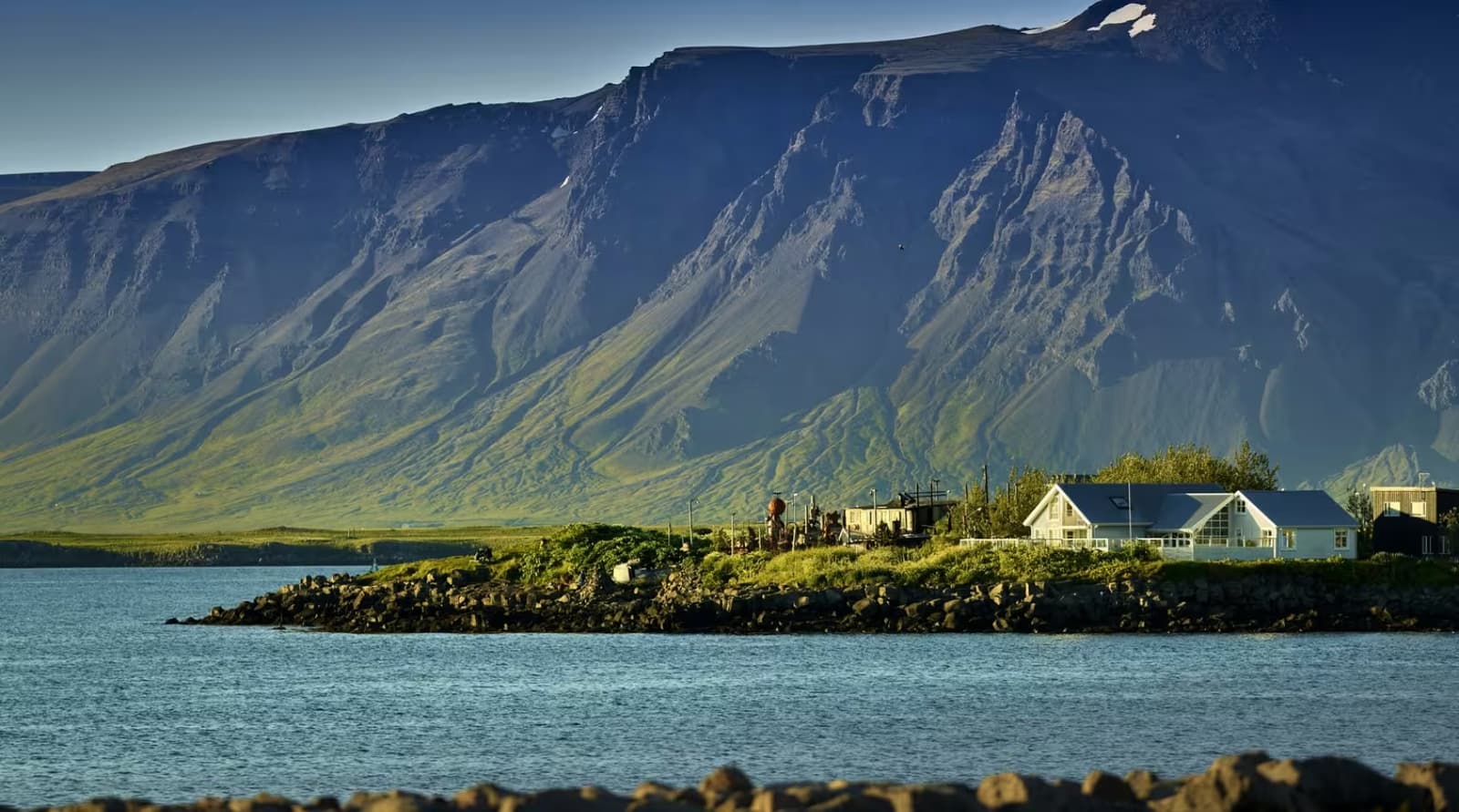
Esjan is the mountain range that forms Reykjavík's northern horizon. Its best-known walk climbs from Mógilsá to Steinn, a marked 6.6-kilometre route with about 600 metres of ascent and broad views over the capital and Faxaflói Bay.
Hike facts
Mountain
A 914 m mountain range on Reykjavík's northern horizon
Steinn route
6.6 km on the official trail profile
Ascent
About 600 m from the Mógilsá parking area to Steinn
Walking time
Usually 2-3 hours for the described Steinn route
Trail
Marked, unlit, mixed soil, stone, and grass; winter ice spikes may be necessary
In this guide
Esjan, the mountain that faces Reykjavík
Esjan is not a single neat summit but a long, steep-sided mountain range that dominates the northern view from Reykjavík.
The highest point reaches 914 metres, while the familiar hiking destination is Steinn on the shoulder below Þverfellshorn. From the city, Esjan reads as a broad wall across Faxaflói Bay. On the mountain, the perspective reverses: the capital, bay, islands, farms, and roads spread out below the trail. That connection to the city is what makes Esjan distinctive among Icelandic hikes.
The lower slopes offer several marked choices, but most first-time visitors come for the established climb from Mógilsá to Steinn. It is a proper mountain walk rather than an elevated city viewpoint. If you want a shorter local climb, Úlfarsfell requires less ascent; if you need a sheltered, step-free view, Perlan serves a different purpose.
Photo guide
Esjan in photos
Esjan is part of the Reykjavík skyline before it becomes a hiking decision.
The marked Esjan hike to Steinn
The Icelandic Tourist Board lists the marked route to Steinn as 6.6 kilometres, usually taking two to three hours.
The walk begins at the Mógilsá parking area in Kollafjörður. It gains about 600 metres on mixed soil, stone, and grass. The official route is marked at regular intervals and graded medium difficulty, but markings do not remove the physical work: the ascent is sustained, the ground is uneven, and the same route is retraced downhill. There is no trail lighting.
A footbridge leads toward Þvergil, and the path later divides near Smágil. Follow the signs for the version you intend to walk rather than treating every visible track as interchangeable. Restrooms are listed at the trail area, but the mountain itself has no shelter or staffed assistance. Carry what you need for the climb and return.
Mountain height, approximate ascent to Steinn, setting, and capital-area context.
Steinn is a complete destination
Steinn is where many hikers should turn around, not a checkpoint that must be passed.
The terrain above Steinn becomes steeper and more demanding. Visit Reykjavík specifically notes that inexperienced climbers commonly stop here, while the upper slopes can hold substantial snow. Reaching Steinn already delivers the sustained climb and the wide view that define the outing. Continuing only makes sense when the surface, wind, visibility, daylight, and your experience all support it.
In winter, the Icelandic Tourist Board says ice spikes are necessary because the path can be very icy. Snow can remain high on Esjan when Reykjavík streets are clear. In any season, sturdy footwear and layers belong on the walk; a 914-metre mountain can be colder, windier, and less visible than the waterfront below.
Let conditions decide your Esjan hike
The view is central to Esjan, so poor visibility can remove much of the reward while increasing the navigation burden.
Check the Icelandic Met Office for wind, precipitation, visibility, and active warnings just before departure. SafeTravel adds current alerts and general outdoor preparation. These checks matter even when the mountain looked clear earlier: conditions can change while you climb, and the exposed upper trail offers little protection.
Esjan works well for travelers staying in the Reykjavík region who genuinely want a hike. It is a poor substitute for a simple panorama, and it does not need to be attached to a long sightseeing circuit. Give the trail its own time, choose Steinn as the default goal, and leave it for another day if cloud, wind, ice, or fading light makes that goal unreasonable.