Geology snapshot
- Type
- Basalt pavement and short geology stop
- Area
- East of Kirkjubæjarklaustur on Route 203
- Best for
- A quick Klaustur leg stretch
- Time
- About 15 to 30 minutes
- Nearby
- Stjórnarfoss and Systrastapi
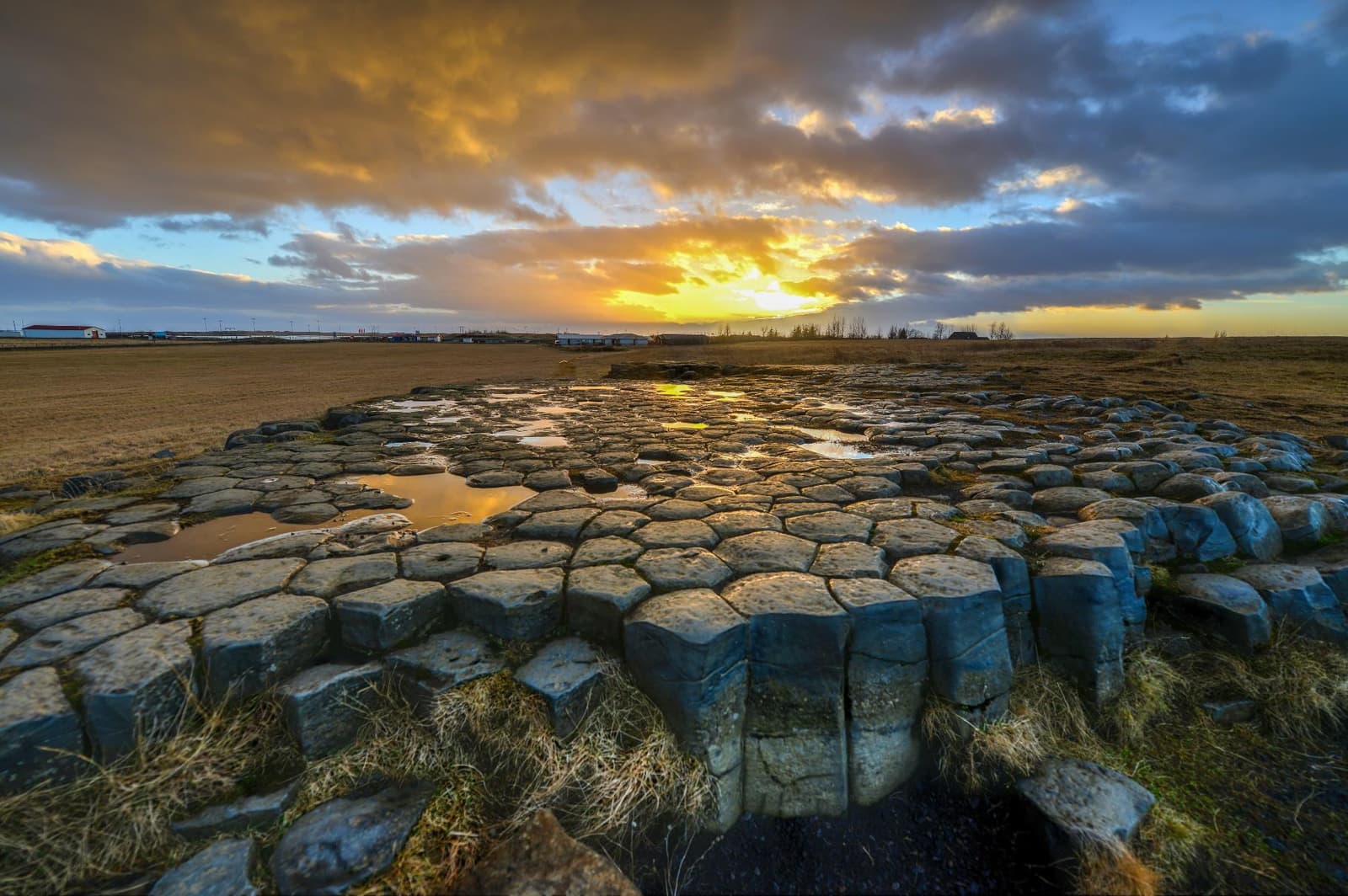
Kirkjugólf is a small basalt pavement east of Kirkjubæjarklaustur, worth adding when your South Coast day needs one unusual geology stop with a short walk and strong nearby pairings, but not when you need a major destination.
Geology snapshot
Usually yes if you are already pausing around Kirkjubæjarklaustur and want one unusual geology detail that only needs a short walk. It is much less convincing if you are hoping for a big stand-alone South Coast attraction.
Kirkjugólf works best as a leg-stretch stop with one memorable visual trick: the basalt surface looks enough like laid stone that the name “church floor” still makes instant sense when you see it. The payoff is curiosity and texture, not scale.
That makes the travel judgment simple. Kirkjugólf belongs in the day when your route already includes Kirkjubæjarklaustur or nearby village-side stops. It loses its case quickly when the same day still needs full time for Fjaðrárgljúfur Canyon, Skaftafell, or a longer southeast push.
The surprise is how low and small the attraction is. You are looking at the exposed tops of basalt columns in the grass, not a cliff or a cave wall.
Local sources describe the surface as about 80 square meters, which is exactly why expectations matter. This is not a long basalt promenade. It is a compact patch of hexagonal stone where erosion has exposed the column tops so neatly that the ground reads like old paving.
That small scale is part of the charm rather than a weakness. The stop feels odd, specific, and easy to absorb in a few minutes. If you are already comparing nearby basalt-related stops such as Eldhraun, Kirkjugólf is the cleaner close-up detail while Eldhraun does the bigger landscape work.
Kirkjugólf is easy to underestimate because it looks simple, but the protected-status point is more important than the effort required to reach it.
The Environment Agency lists Kirkjugólf as a protected natural monument, and the place makes more sense if you treat it like one. The value is in seeing the basalt pattern clearly without turning the stop into a scramble for better angles or a reason to step where the ground should be left alone.
In practice, that means keeping the visit flexible. If the surface is wet, the weather is ugly, or signage makes the right boundary obvious, a short respectful look is enough. This page should help you judge the stop, not pressure you into squeezing more out of a protected patch of stone.
Kirkjugólf does not need a complex planning ritual, but it also should not be treated like a frictionless throwaway stop when weather or timing are already working against the day.
The practical checks are simple: make sure the drive still works, let the weather decide whether a short exposed stop feels worthwhile, and treat local signs as the final word on how the protected area should be approached. If those basics start to feel awkward, the right move is often to leave Kirkjugólf as a quick look or move on.
Use for protected-status context and low-impact visiting expectations.
Use before building a weather-sensitive South Coast stop into a tight drive.
Use for wind, rain, and visibility checks before exposed stops.
Use for travel alerts and safer day-of route choices.
Kirkjugólf becomes much more useful when you treat it as one piece of a small Kirkjubæjarklaustur cluster rather than as a lonely roadside curiosity.
That is the page’s most useful secondary angle. Local visitor material places Kirkjugólf on the wider village-side walking circuit with landmarks such as Hildishaugur and Stjórnarfoss Waterfall. It also sits naturally beside Systrastapi, where the stop shifts from basalt geometry to folklore and broader views.
If you only want one quick Klaustur-area stop, decide what kind of memory you want. Kirkjugólf is the odd geology detail. Stjórnarfoss is the easier waterfall pause. Systrastapi is the story-and-view option. The wider Kirkjubæjarklaustur page helps if you want to shape them into one slower break between Vík and the Skaftafell side of the South Coast.
By ThorPublished Updated
Map
Use nearby places and useful bases before opening directions.
Interactive planning map for Kirkjugólf
Interactive map
Place context and external map links remain available without loading it.
Planning context
Open the region or practical guide that resolves the next planning decision.
Wider route
Use broader place relationships for route comparison; they are not presented as immediate nearby stops.
Next step
Use the next page that helps turn this stop into a practical route decision.