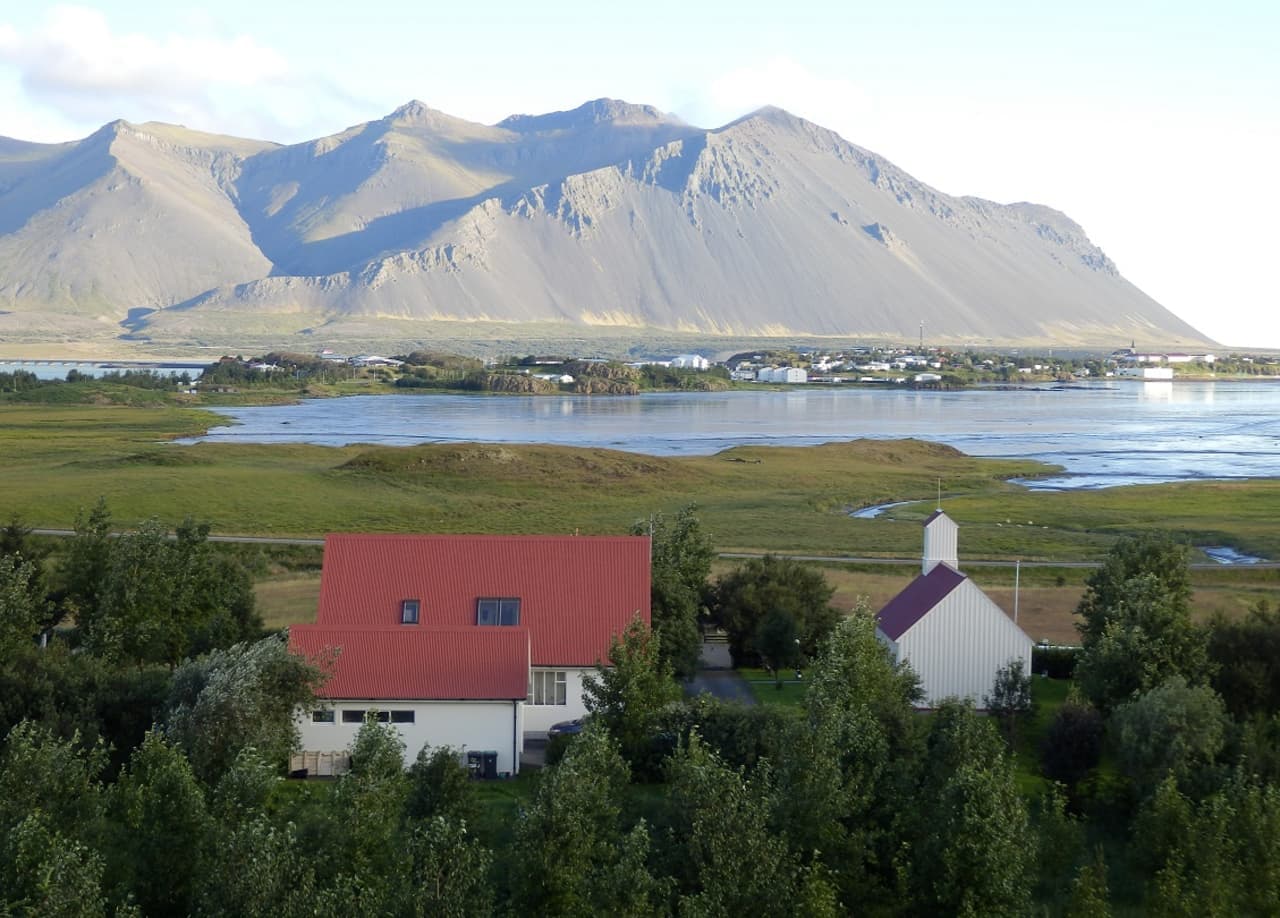
Borg á Mýrum is a small church and farm site near Borgarnes in West Iceland. Its landscape, church built in 1880 and Sonatorrek sculpture connect directly with Egils saga today.
Culture snapshot
Historic role
Farm of Skalla-Grímur and his family in Egils saga
Church
Present building erected in 1880
Sculpture
Sonatorrek by Ásmundur Sveinsson, erected in 1985
Time to allow
About 10-25 minutes for the exterior, sculpture and setting
Borg á Mýrum gives Egils saga a physical setting
The farm stands west of Borgarnes at the head of Borgarvogur, in the landscape associated with Skalla-Grímur Kveldúlfsson and his son Egill.
According to Egils saga, Skalla-Grímur settled at Borg after his family came to Iceland. Egill grew into one of the saga age's most memorable figures: a farmer, warrior and poet whose story remains closely tied to Borgarfjörður. The site matters because it places that literary family in a real farm landscape rather than presenting the saga only as text.
Interior imagery is included only as place-specific context; check official visitor details before depending on entry.
The church and Sonatorrek carry different layers of history
The present white church was erected in 1880, while the sculpture outside turns one of Egill's most personal poems into a modern memorial.
Inside the church is an altarpiece by English artist W.G. Collingwood, painted after his 1897 journey in Iceland. Interior entry should not be assumed, but the exterior remains the clearest architectural marker at the farm.
The 1880 church is the most immediate landmark at the historic farm.
Ásmundur Sveinsson's Sonatorrek was erected here in 1985. Its title comes from Egill's poem mourning the loss of his sons, giving the quiet site an emotional focus that is easy to miss without knowing the story.
Sonatorrek links the farm landscape to Egill's grief as a poet and father.
About 10-25 minutes is enough to see the church, sculpture, name-giving rock and surrounding landscape from the public exterior area.
Borg á Mýrum is not a large attraction with a sequence of exhibits. It works best after some background reading or alongside the Settlement Center, where the settlement story and Egils saga receive fuller interpretation. Borgarnes provides the wider local setting.
Stop when the saga connection genuinely interests you; otherwise the farm may feel like a small church and sculpture in open countryside. That honest scale is part of its appeal and the reason it should remain a brief cultural page.