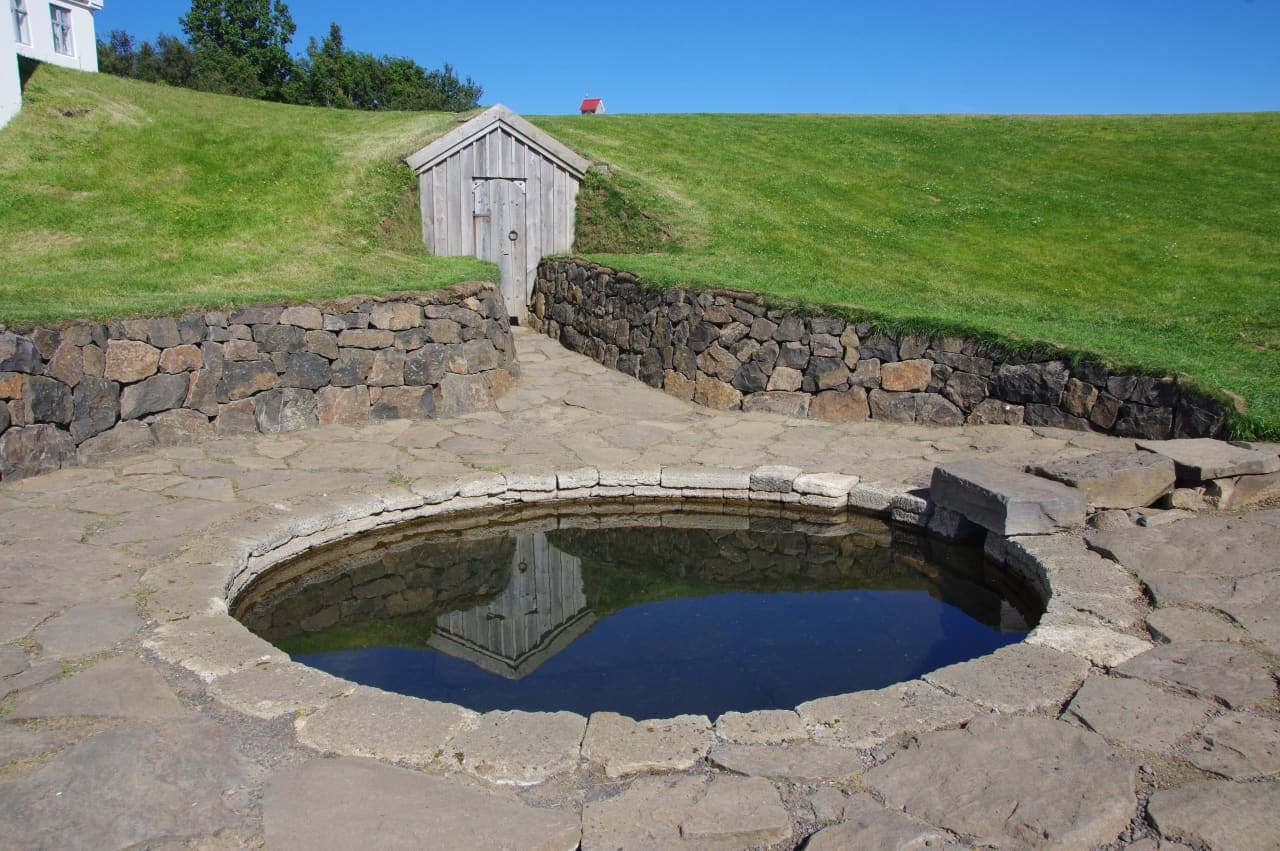
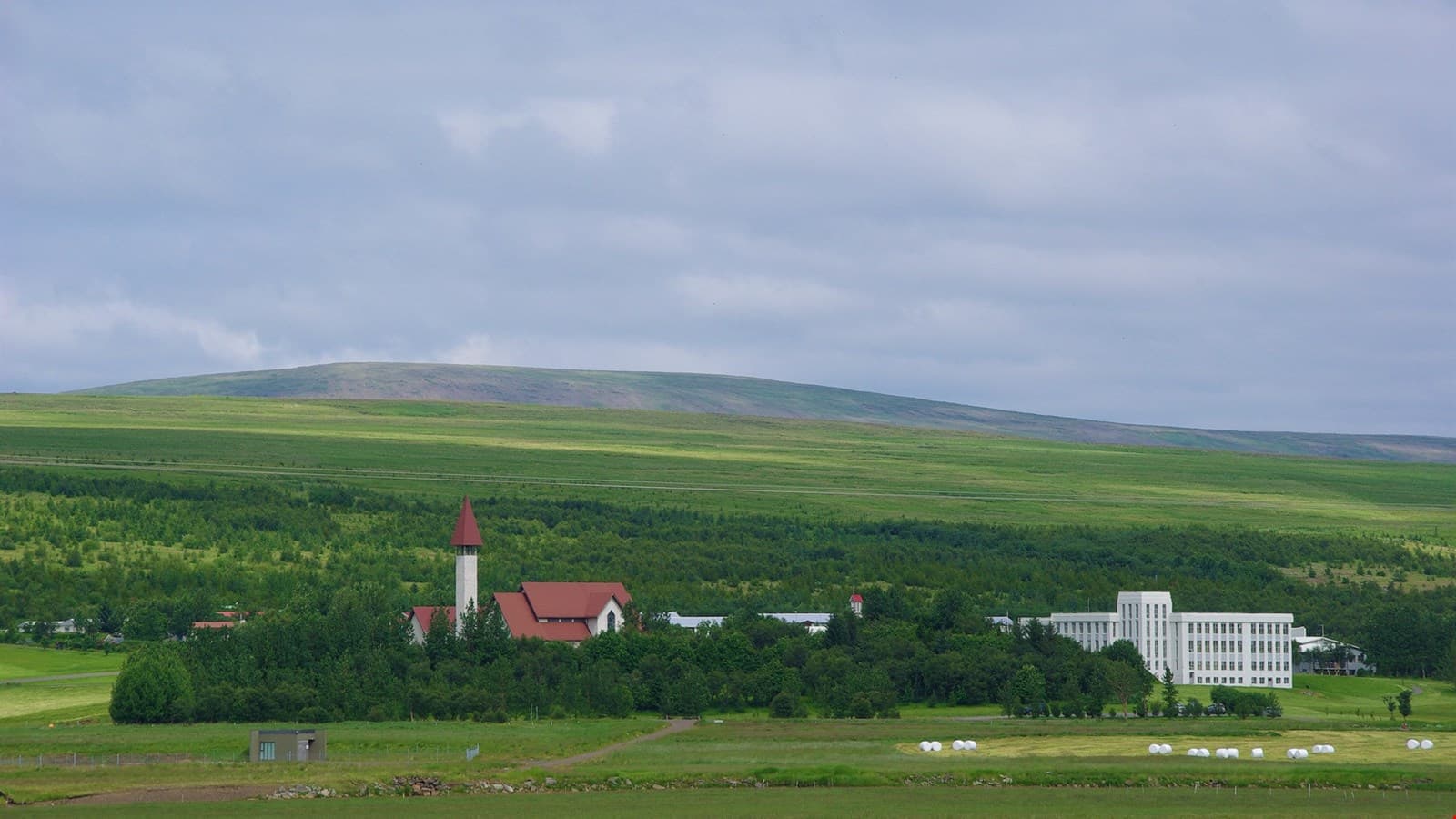
Snorralaug is a protected historic geothermal pool in Reykholt and one of Iceland's first listed archaeological remains; bathing is forbidden because the water can be extremely hot, so its value is history, not soaking.
Bathing details
Type
Preserved medieval geothermal pool and historic site
Region
Reykholt in Borgarfjörður, West Iceland
Route context
Best as a short Silver Circle history stop rather than a standalone detour
Time to allow
About 15-30 minutes for the pool itself, or 45-90 minutes with Reykholt and Snorrastofa
Best experience
Pair the pool with Snorrastofa or a wider Reykholt stop so the place has story as well as scenery
In this guide
Snorralaug earns a stop for protected history, not for bathing
Add Snorralaug when the day already passes through Reykholt and the group wants a short, tangible encounter with medieval history. It is not a hot-pool experience: bathing is forbidden and the water can be extremely hot.
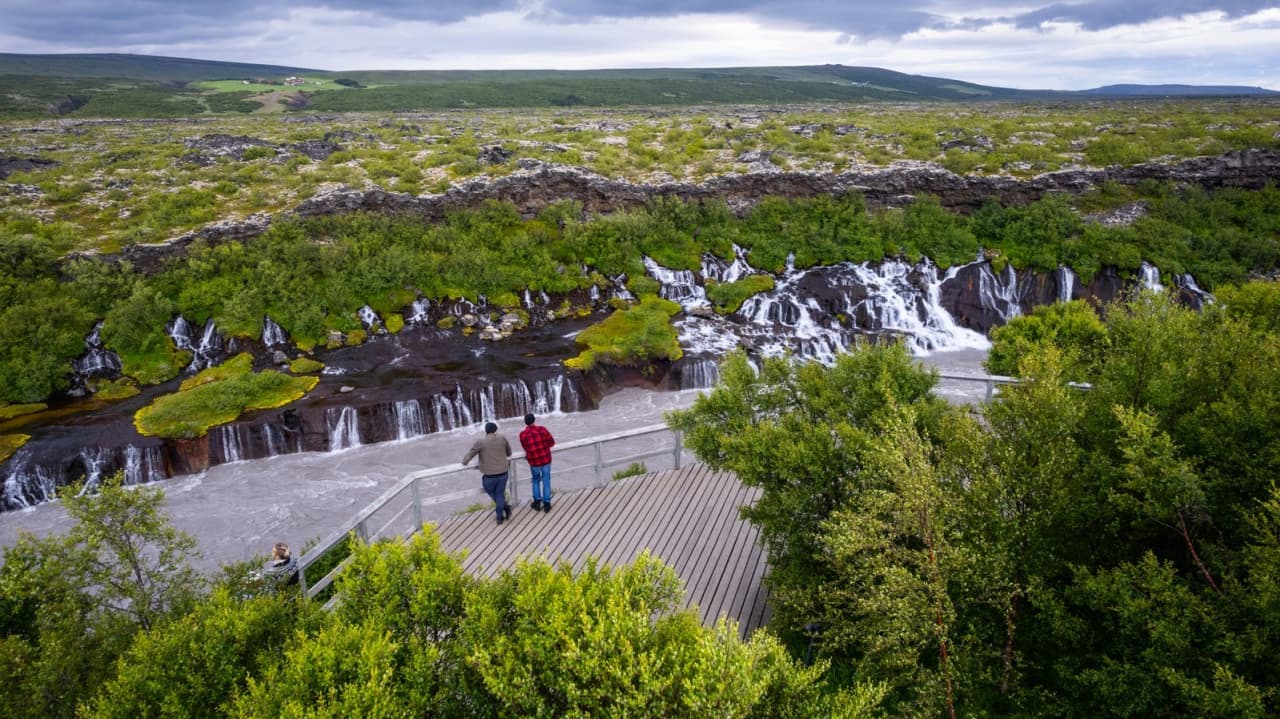
The pool works best as a short add-on, not as a day-defining destination. If your route already points toward Snorrastofa, Hraunfossar Waterfalls, Barnafoss Waterfall, or Deildartunguhver Hot Spring, Snorralaug gives the area a deeper sense of place without adding much time.
The decision is unusually clear. Choose Snorralaug for the physical evidence: the stone basin, water conduit from Skrifla, protected remains, and the site associated with Snorri Sturluson. Choose Hraunfossar for scenic scale, Deildartunguhver for active geothermal power, or a purpose-built pool for bathing.
Keep it brief when Reykholt is only one piece of a crowded inland route; give it more time with Snorrastofa when the history is the reason for coming. That distinction prevents a small protected site from being oversold while still giving it a clear role in a Silver Circle day.
What is original, protected, and reconstructed at Snorralaug?
Snorralaug is a protected archaeological site associated with medieval Reykholt, but the Cultural Heritage Agency is explicit that the pool's present appearance and closest surroundings are not wholly original.
Snorralaug was among the first ten archaeological remains listed in Iceland in 1817. The basin is about 4 m in diameter and 0.7–1.0 m deep, built of cut silica-sinter stone, with thermal water led from Skrifla through a conduit. Those concrete details are what distinguish the site from a generic old hot pool.
Snorralaug makes the most sense when you see it as part of Reykholt's wider church and cultural landscape.
A passage said to connect the farm and basin was found during construction work in 1931. The visible front section was reconstructed, and the small building over it protects the remains rather than recreating a proven medieval entrance. The pool and its setting have also been repaired repeatedly, most recently by the heritage authority in 2019. Read the site as conserved evidence shaped by restoration—not as an untouched medieval scene.
What the protected site evidence tells you
Evidence
Verified context
Why it matters
Stone basin
About 4 m across and 0.7–1.0 m deep
Shows the pool's real compact scale
Skrifla conduit
Carries thermal water from the nearby spring
Connects the pool to Reykholt's geothermal system
Covered passage
Remains found in 1931; visible entrance section reconstructed
Protection structure is not proof of the original appearance
1817 listing
One of Iceland's first ten listed archaeological remains
Explains why conservation rules outweigh visitor use
What does the stop actually feel like when you arrive?
Expect a small, quiet, place-specific stop where the value comes from atmosphere and context, not scale.
Snorralaug does not hit like a major waterfall or a dramatic geothermal field. It feels compact and grounded: a stone-lined pool, close views of the water, a grassy historic setting, and a sense that the important part is what happened here rather than how far you can walk.
The stop is small on the ground, which is part of why it works best as a deliberate short look rather than a long visit.
That small scale matters for planning. If you want active geothermal drama, Deildartunguhver Hot Spring is the clearer stop. If you want to bathe, choose a lawful purpose-built bathing facility: Snorralaug is protected, bathing is forbidden, and its water can be extremely hot.
Snorralaug rewards travelers who enjoy small place-specific details more than travelers chasing a big visual spectacle.
How much time should you allow and what pairs well nearby?
Most travelers only need a short stop, but the same Reykholt area can expand into a fuller cultural-and-scenic cluster if the day has room.
The compact basin and protective structure make Snorralaug read as a conserved archaeological site rather than a bathing facility.
Simple ways to fit Snorralaug into the day
Version
Best use
What to pair with
Quick stop
See the pool, take a short look around, and continue driving.
Snorrastofa or one major scenic stop.
Balanced Reykholt stop
Use the pool as part of a slower historic pause in the village.
Snorrastofa and one or two inland Silver Circle sights.
Full inland cluster
Build a wider Borgarfjörður day with history, geothermal texture, and waterfalls.
For most first-time visits, Snorrastofa is the best immediate pairing because it explains why Reykholt matters at all. Hraunfossar Waterfalls and Barnafoss Waterfall are the strongest scenic continuation. Deildartunguhver Hot Spring adds geothermal contrast, while Húsafell and Víðgelmir only make sense if the route still has enough time and purpose.
If you are still deciding whether this inland cluster deserves part of the trip, use West Iceland first. It is the right planning page when the bigger decision is not just Snorralaug, but whether the whole Reykholt and Borgarfjörður section fits the trip at all.
What should you check before you rely on Snorralaug?
Check practical details only when they matter to your plan, and let official sources handle anything that can change.
If the stop depends on interpretation, exhibitions, or visitor services, check official visitor information from Snorrastofa before you build the day too tightly around Reykholt. The durable plan is to know why the stop matters first, then verify the visitor details that matter to your group.
Road conditions, weather, and daylight still matter for West Iceland pacing, especially outside the easiest summer driving window. Winter Driving in Iceland becomes more relevant the moment this stop is part of a larger inland loop rather than a casual extra.
These are the practical questions most likely to change whether the stop belongs in the day.
Can you treat Snorralaug as a bathing stop?
No. The Cultural Heritage Agency of Iceland states that bathing is forbidden and warns that the water can be extremely hot. Visit Snorralaug only as a protected historic site.
Do you need Snorrastofa to make Snorralaug worthwhile?
No, but the stop is stronger with Snorrastofa. Without that pairing, Snorralaug usually works best as a brief look during a slower Reykholt or Silver Circle day.
How much time does Snorralaug need?
Most travelers only need about 15-30 minutes at the pool itself. Allow longer only if Reykholt, Snorrastofa, or a wider inland cluster is part of the same stop.
Is Snorralaug better in summer or winter?
The historic stop can work in either season, but the route around it changes. Winter requires more attention to road conditions, weather, daylight, and whether the stop still earns its place in a tighter day.