Eggin í Gleðivík is a harbor-side outdoor artwork in Djúpivogur, best for travelers who want a short Eastfjords landmark stop with birdlife context, mountain views, and an easy decision on whether the detour deserves more than a quick photo.
Quick guide
Type
Harbor-side outdoor sculpture and Djúpivogur landmark
Region
Djúpivogur in East Iceland, just off the Ring Road corridor
Typical visit
A short harbor walk and photo stop, or a longer pause when folded into Djúpivogur time
Time to allow
About 15-30 minutes on its own, or 45-90 minutes with a slower waterfront and town pause
Effort
Low walking effort on the waterfront, with comfort shaped by wind, rain, slick surfaces, and visibility
What makes it specific
Thirty-four granite egg sculptures tied to local birdlife and set on reused industrial supports
Nearby pairings
Djúpivogur town time, Papey, Teigarhorn, Berufjörður, Egilsstaðir, or a bigger East Iceland stop such as Hengifoss
Check before
Use official visitor information, road conditions, and weather guidance if local access comfort or the wider Eastfjords drive matters
Is Eggin í Gleðivík worth a stop in Djúpivogur?
Yes, if Djúpivogur already sits naturally on your East Iceland day and you want one compact landmark that feels specific to the harbor. No if you are only adding it to prove you squeezed in another named stop.
Eggin í Gleðivík is strongest as a short pause with character. You get a harbor walk, a clear visual identity, and a sense that Djúpivogur has more personality than a fuel-and-continue stop, all without turning the day into a major detour.
Eggin í Gleðivík quick decision guide
Choice
Works when
Watch out for
Go
Djúpivogur already fits the day and you want a short landmark with a real sense of place.
The stop is compact; it should not displace the day's main scenic anchor.
Keep flexible
You want a waterfront pause but weather, visibility, or the wider drive could still reshape the day.
Wind, rain, or slick surfaces can make a short exposed walk feel less worthwhile.
Skip
You would only jump out for proof that you visited another named stop.
Use the time for Papey, Hengifoss, or simpler driving margin instead.
Photo guide
Eggin í Gleðivík in photos
1 / 4
The landmark makes most sense when the wider Eastfjords scenery is already part of the day.
Worth the stop?
When this stop makes sense
Good match for
travelers already stopping in Djúpivogur or nearby on the Ring Road
short Eastfjords pauses with a clear sense of place
photographers who like harbor foregrounds with mountain backdrops
travelers who want culture and birdlife context without a long walk
Think twice if
drivers forcing too many East Iceland detours into one long transfer day
travelers who only value big hikes, major museums, or dramatic natural spectacles
What exactly are the granite eggs and why are they here?
The stop is not random roadside sculpture. The artwork is tied closely to Djúpivogur, its birdlife, and the old harbor infrastructure beside the bay.
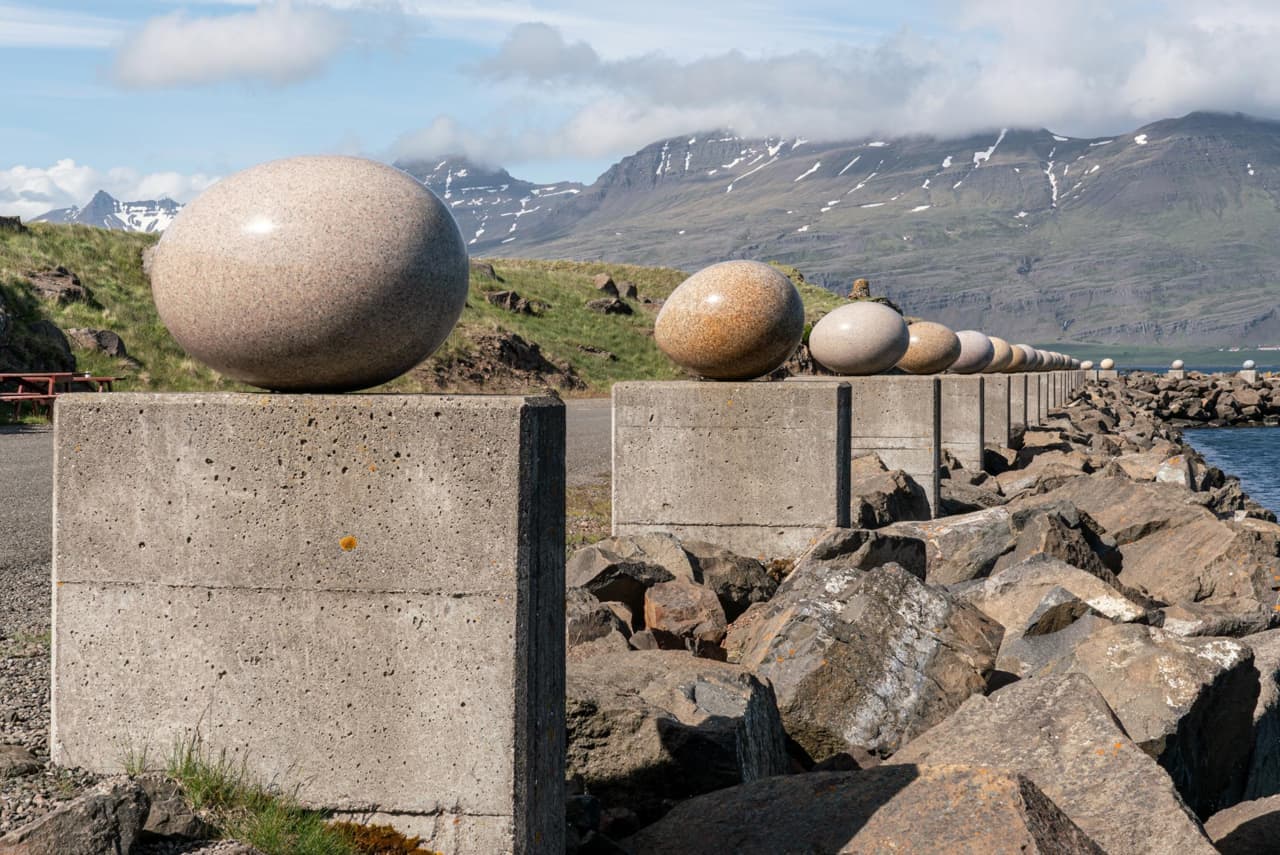
Eggin í Gleðivík is an outdoor work by Sigurður Guðmundsson made up of 34 granite replicas of eggs from birds that nest in the Djúpivogur area. The sculptures sit on concrete supports that once carried a landing pipe between the pier and the smelter, which gives the line of eggs a stronger harbor logic than a normal public-art installation.
The full line of eggs matters because the harbor setting is part of the artwork, not only the individual sculptures.
That local grounding is why the stop works best when you slow down enough to notice the shoreline, the birdlife story, and the wider harbor backdrop. If Papey is also on the plan, the eggs make even more sense as a first layer of the area's bird-focused identity.
What does the harbor walk feel like once you arrive?
Expect an easy waterfront stop with more atmosphere than effort. The visit is about the line of sculptures, the sea air, and the mountains lifting behind Djúpivogur rather than about a long list of things to do.
The best version of the stop is not rushed. Walk the line of eggs, look back toward the harbor, and let the town and mountain backdrop explain why this feels like a local landmark rather than a generic sculpture park. If you are moving slowly, the stop can blend naturally into a wider Djúpivogur walk or a longer East Iceland day built around Egilsstaðir.
One sculpture works best as a detail inside a broader harbor pause, not as the whole reason to stop.
The same stop can feel very different in wind or poor visibility, so keep expectations flexible. This is a place where weather shapes comfort more than difficulty, and that matters most when Eggin í Gleðivík is only one piece of a longer drive.
How much time should you give Eggin í Gleðivík?
Most travelers only need a short stop, but the right amount of time depends on whether the eggs are a quick landmark, part of Djúpivogur time, or a warm-up for a slower local day.
Simple timing choices for Eggin í Gleðivík
Visit style
Time
Best when
Quick look
15-20 minutes
You want the landmark, the harbor setting, and a few photos before continuing.
Balanced stop
30-45 minutes
You want time to walk the line, look around the waterfront, and avoid a rushed checkbox feel.
Slower local pause
45-90 minutes
You are combining the eggs with more Djúpivogur time or shaping the day around a nearby stop such as Papey.
If the day still needs a bigger scenic commitment, keep Eggin í Gleðivík short and save the extra time for Hengifoss or a longer East Iceland stretch. The page works best when one compact landmark supports the day instead of quietly overrunning it.
What pairs best with Eggin í Gleðivík nearby?
The strongest pairings stay honest about rhythm. This is a landmark stop, so it works best when matched with one bigger East Iceland decision rather than a pile of unrelated extras.
Papey is the best same-area upgrade when you want Djúpivogur to become a slower wildlife and boat-based outing.
Egilsstaðir is the practical inland base when Eggin í Gleðivík is only one short East Iceland pause inside a longer drive.
Hengifoss works well when you want one easy landmark and one real hike in the same broader East Iceland plan.
Seyðisfjörður is a second fjord-town contrast only when the trip has enough time for another deliberate detour, not just another photo stop.
Teigarhorn and Berufjörður make sense when you want to keep the day local to Djúpivogur and the southern Eastfjords instead of driving too far inland.
The landmark makes most sense when the wider Eastfjords scenery is already part of the day.
A good local rule is simple: if you are already tempted to add too many Eastfjords detours, let the eggs stay short. If Djúpivogur already has breathing room, the landmark can become the detail that makes the stop feel intentional.
What should you check before building it into the day?
Because the stop itself is simple, the checks that matter are practical rather than complicated: local visitor context, road conditions, and weather.
Use official visitor information when local access details, surfaces, or waterfront comfort matter to your plan. Use official road conditions and official weather guidance before committing to the wider Eastfjords drive, especially if this stop sits inside a longer day with more exposed stretches or tight overnight timing.
If you are building the stop into shoulder-season or winter travel, the better question is not whether the eggs themselves are difficult. It is whether Winter Driving in Iceland principles, daylight, and forecast confidence still support the whole day around Djúpivogur.