
Parliament House facts
- Built
- 1880–81; inaugurated 1 July 1881
- Architect
- Ferdinand Meldahl
- Material
- Hewn basalt from Skólavörðuholt
- Setting
- Austurvöllur square in central Reykjavík
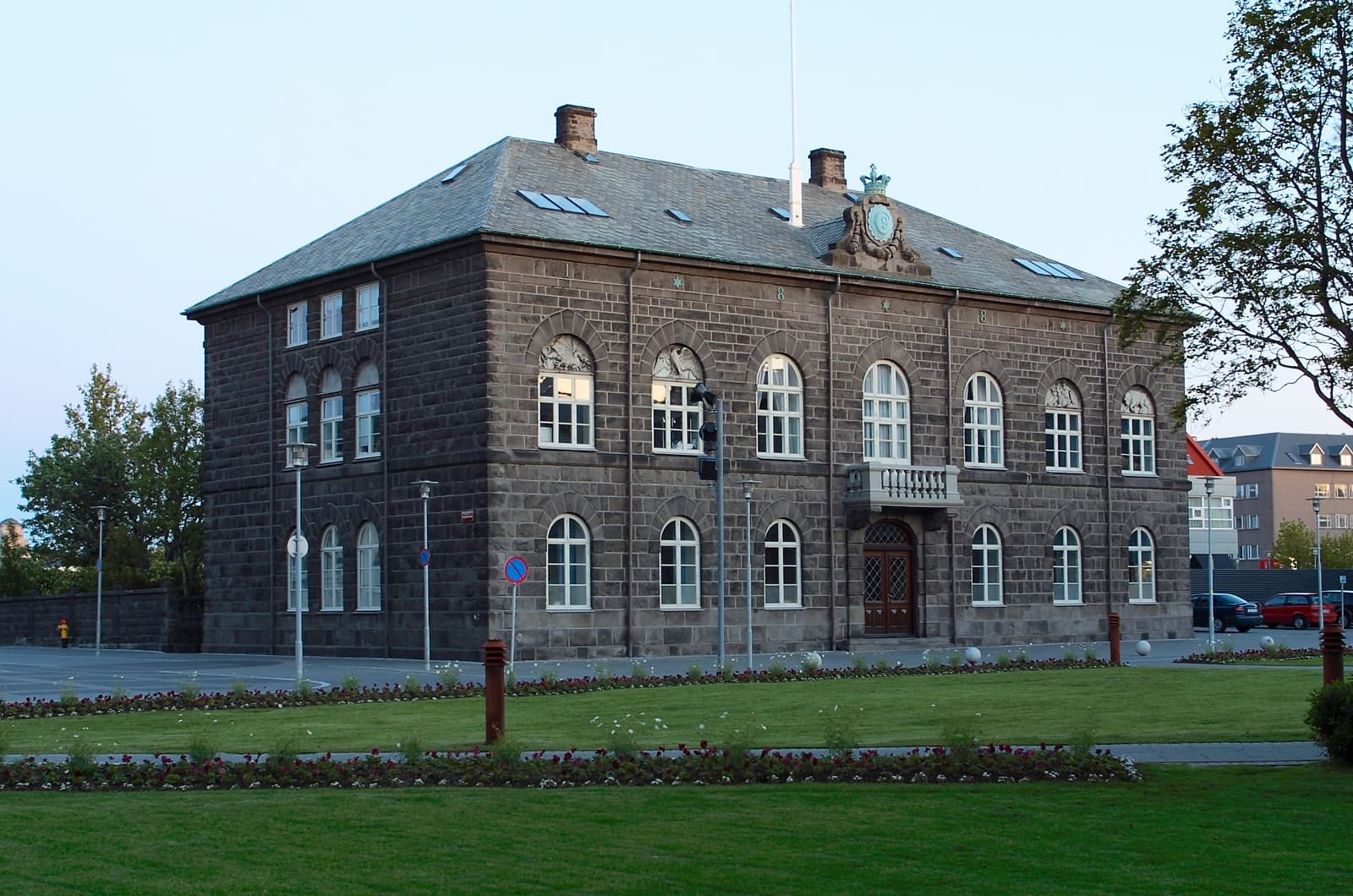
Alþingi is Iceland's parliament. Its compact Parliament House beside Austurvöllur was built in 1880–81 from Icelandic basalt and is best understood as a civic landmark, not a museum.
Parliament House facts
The house was planned as a national building, not simply an office for politicians.
In 1867, Alþingi resolved to mark one thousand years of settlement in Iceland with a national festival and a parliament house made from Icelandic stone. Danish architect Ferdinand Meldahl designed the building, which rose beside Austurvöllur in 1880–81 and was inaugurated on 1 July 1881.
The walls are built from hewn basalt quarried at Skólavörðuholt, where Hallgrímskirkja now stands. On the north facade, look for the date 1881 under the eaves and four low-relief guardian spirits above the upper windows: a giant, bird, bull, and dragon. Dómkirkjan next door makes the square feel like one compact civic setting.
Use for the purpose, architect, construction, materials, facade, annexes, and former uses.
Use for the establishment of the Alþing assembly around 930 and its history at Þingvellir.
Photo guide
1 / 3
The useful visit is often the pair: parliament, cathedral, square, and old-town streets.
The institution and the Reykjavík building belong to different periods of Icelandic history.
The Alþing general assembly was established at Þingvellir around 930 and met there until 1798. Parliament House in Reykjavík is the later home of that political tradition. It gives the old institution a physical place in the modern capital, but it is not the site of the original outdoor assembly.
The building also served more than parliament. It initially housed the National Library, the Antiquities Collection, and the National Gallery. The University of Iceland used rooms here from its founding in 1911 until 1940, and the offices of Iceland's viceroy and later president were in the house from 1941 to 1973.
The dependable visit is the exterior and square. Interior access has a narrower purpose and should be checked in advance.
Allow about 10–20 minutes to see the basalt facade, reliefs, Austurvöllur, and the relationship with the cathedral. From here, Reykjavík City Hall and Tjörnin are close enough to continue the walk without turning Alþingi into a separate excursion.
Alþingi's education team offers 45–60 minute group visits only for educational or academic purposes. They must be arranged well ahead and take place outside parliamentary session time. Meetings can be observed from the public gallery, but current schedules, entry arrangements, and parliamentary activity should come from the official visitor page rather than a fixed travel guide.
Check current group-visit rules, public-gallery information, meeting times, and entrances.
By ThorPublished Updated